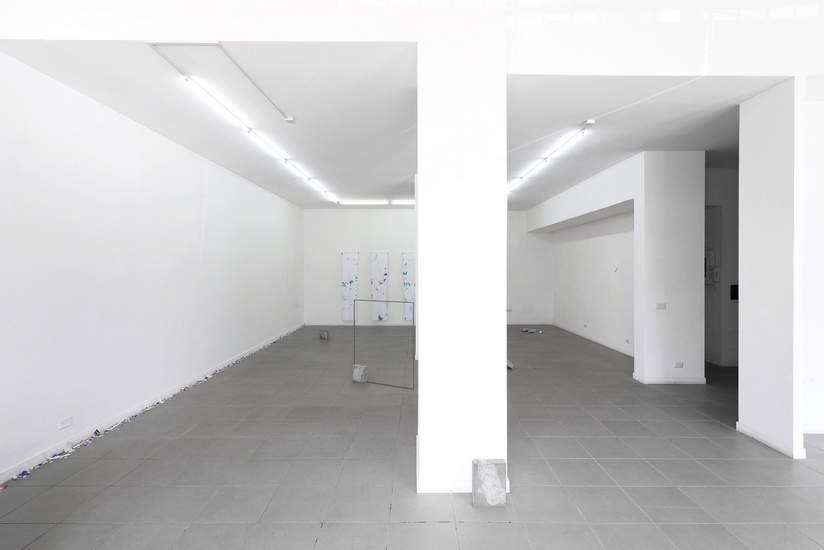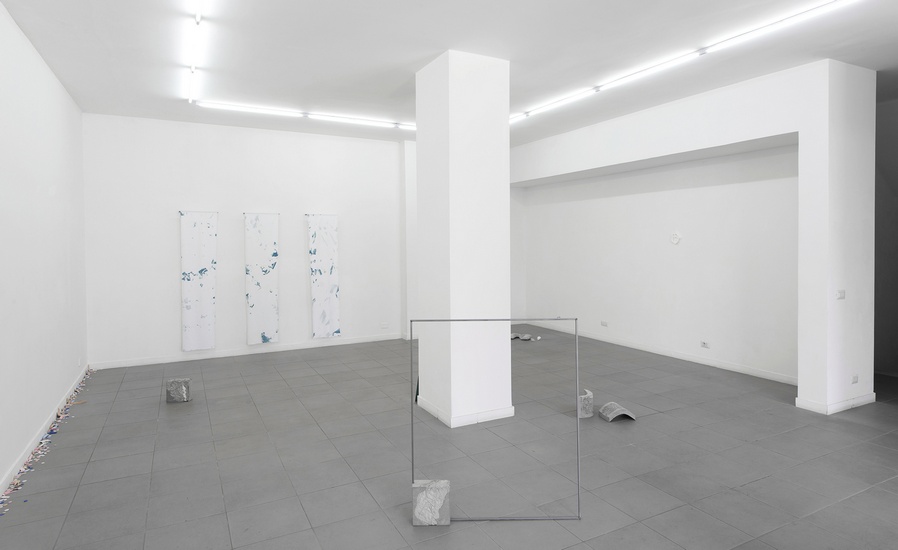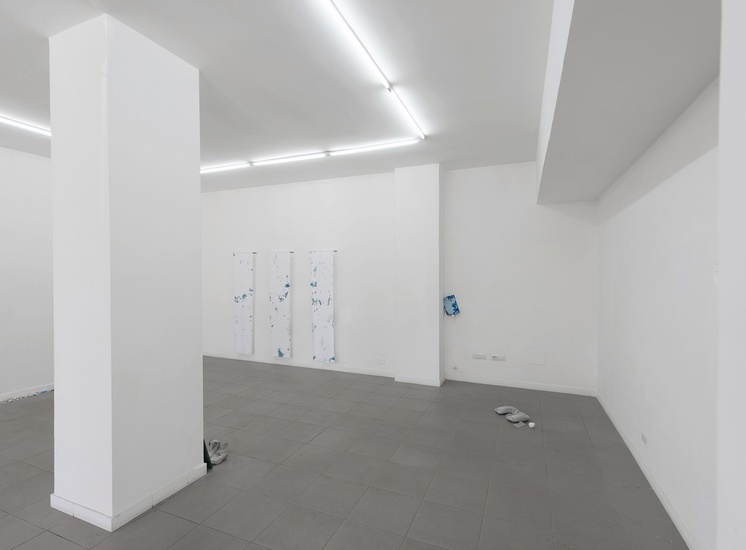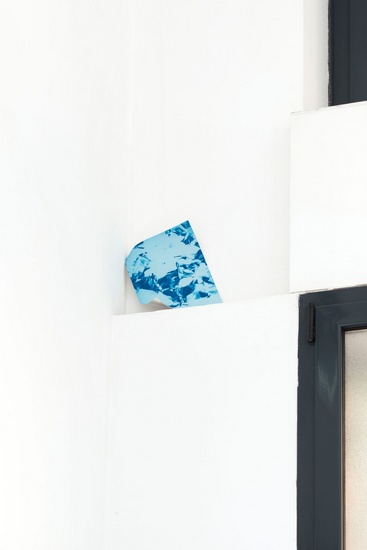
DIMORE

Mariana Ferratto, Rowena Harris, Luana Perilli

10.05.2021 – 12.06.2021

Exhibition Views
Works

Each era presents new junctions that capture attention, polarise opinion, and call for intellectual effort in influence over them, for better or for worse. These junctions arrive when, after a long incubation, great themes of humanity reach the point of maturation, or as sudden urgencies felt in the effects of technological revolution. In their unpredicted arrival such intersections produce a scenario where clashes and entanglements become the mode to explore until either a route is found for humanity to progress, or equally where it will be overwhelmed and undone.

Amongst those which qualify in these terms for our current historical phase at the global level, it may be migration, the pandemic, and climate change as the three key issues that assume maximum importance. Each of these themes is a world in its own right, with infinite facets, implications and consequences – each of strong influence over human and planetary relations, and each determinative of rules, modalities, and qualities of living in the world. Gathered into intersection within the DIMORE exhibition, the works of Mariana Ferratto, Rowena Harris and Luana Perilli offer three partial perspectives as keys to reading this way of living, shown through the diversity of their respective researches, choice of media, and thematics conveyed.

The three artists explore the shape of living through different angles, and where these trajectories converge through their shared approached in circumnavigating the intimate and domestic, in pursuit of the relationship between self and the inhabited environment. Housing can be considered more broadly as the inhabitation of environment – the making of space for the human needs we have to deal – and where the environment is present to this space even if, and indeed when, there will no longer be humanity. Home is the affective, spiritual dimension, of the people closest to us and with whom we share physical and mental space, be they our dearest affections or strangers that we welcome as the gesture of friendship to be built. It is a welcome that starts from the inadequacy of the very concept of migrant, which implies a free will that does not really exist. To be home within one’s own skin, is to speak of the human body as seemingly closed and perfect mechanism that we imagine provide us with a sense of total reliability and protection, when it may instead be a porous home by definition, due to the innate openings of the skin and intrinsic relationality of the human immune system with the environment. 

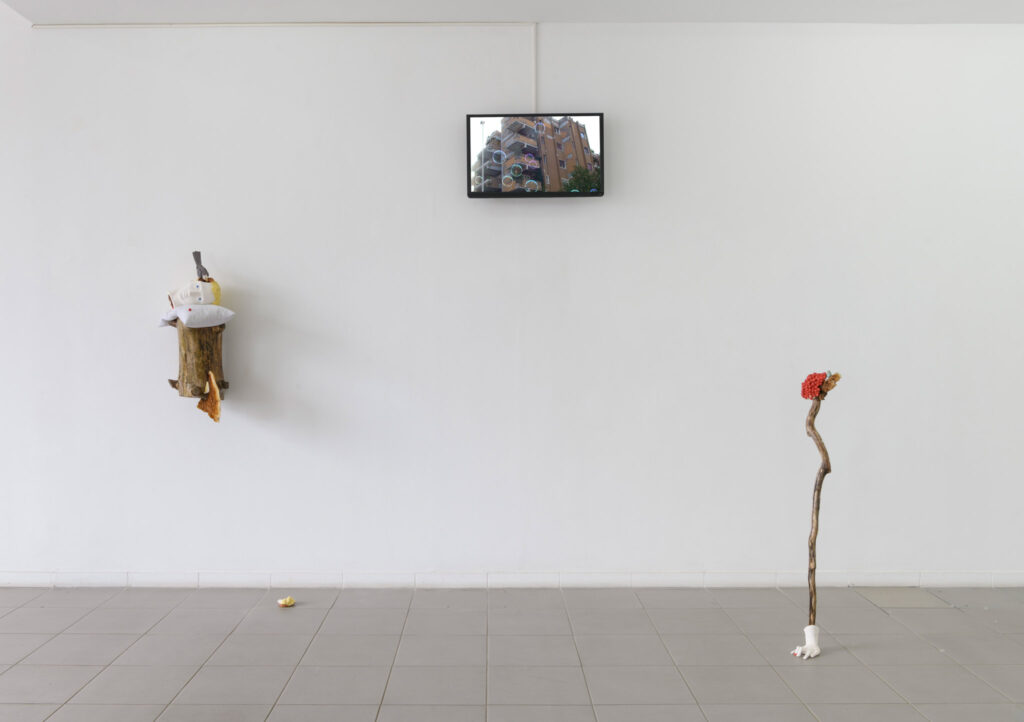
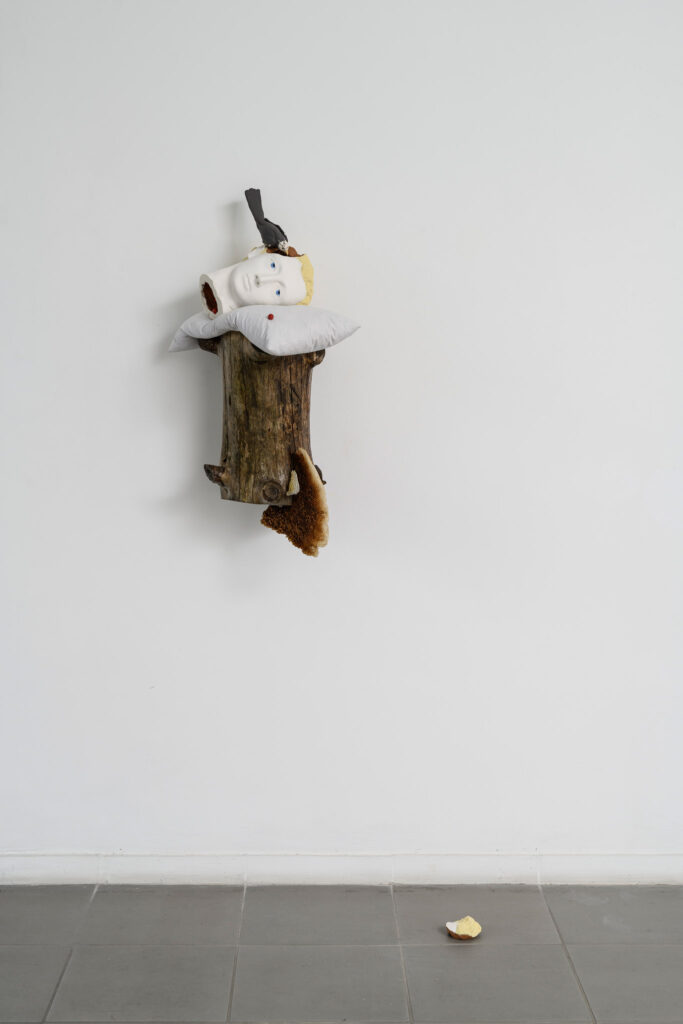
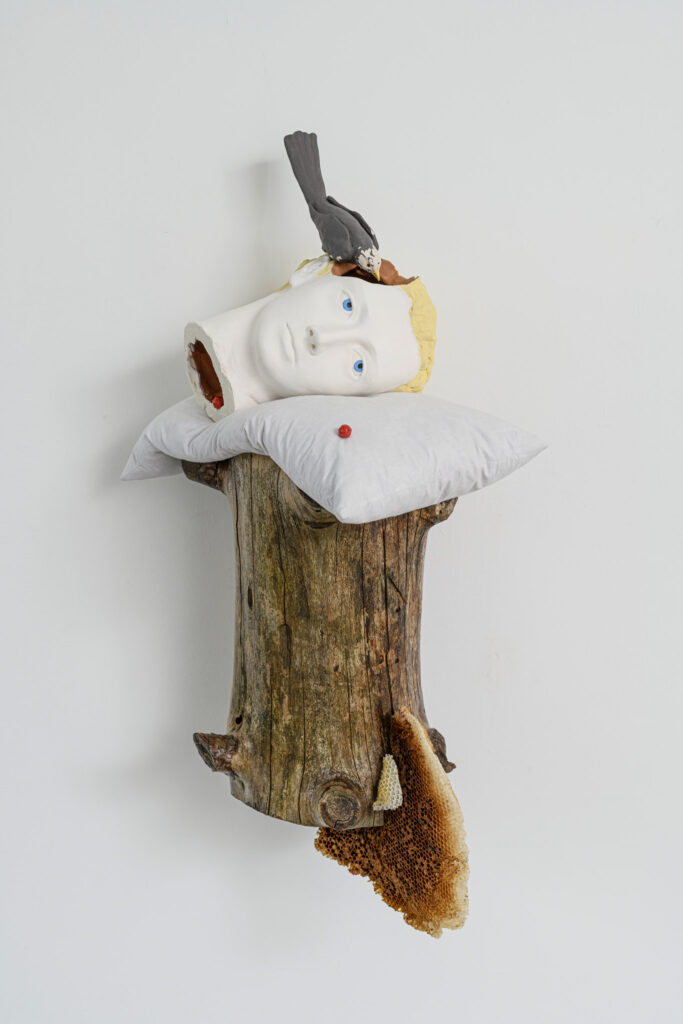
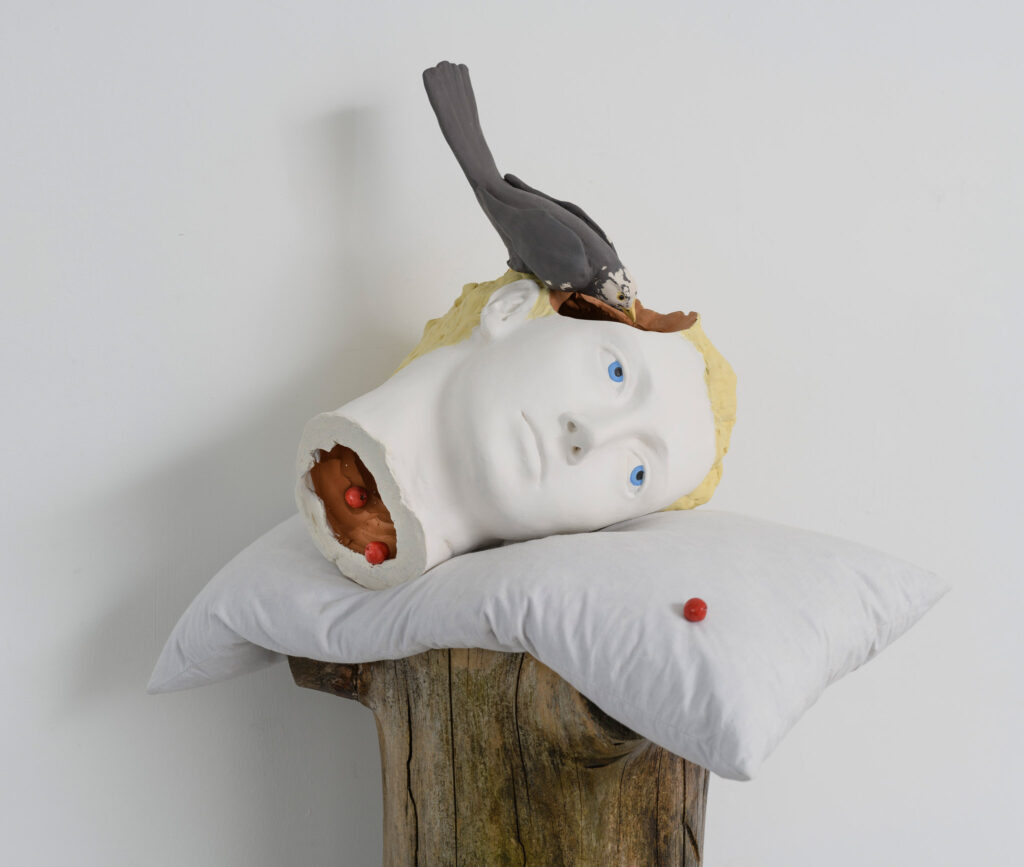
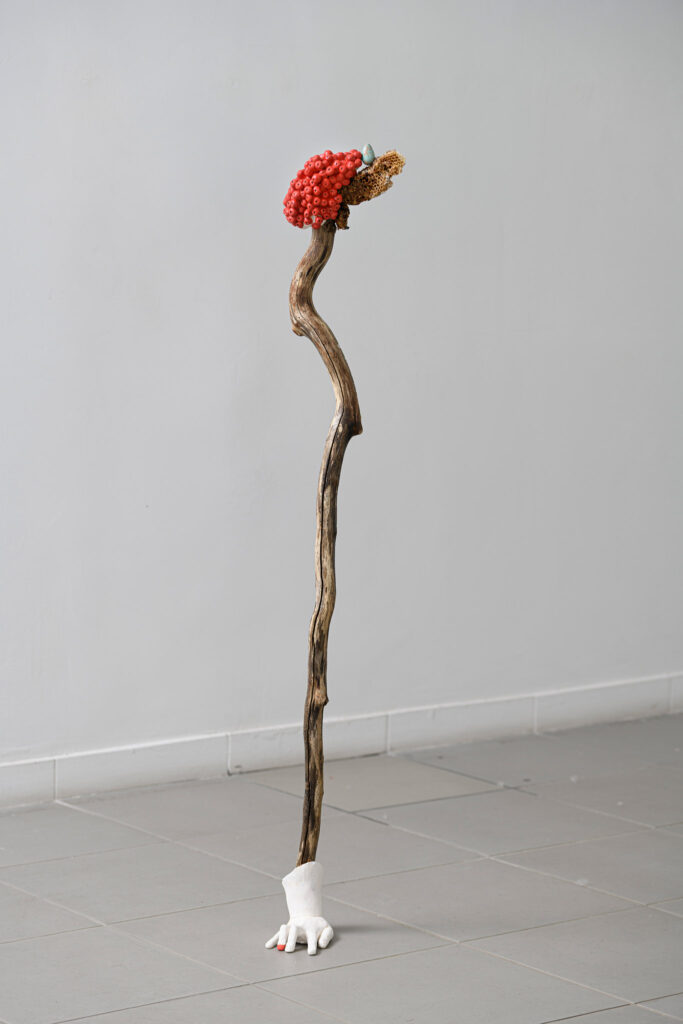
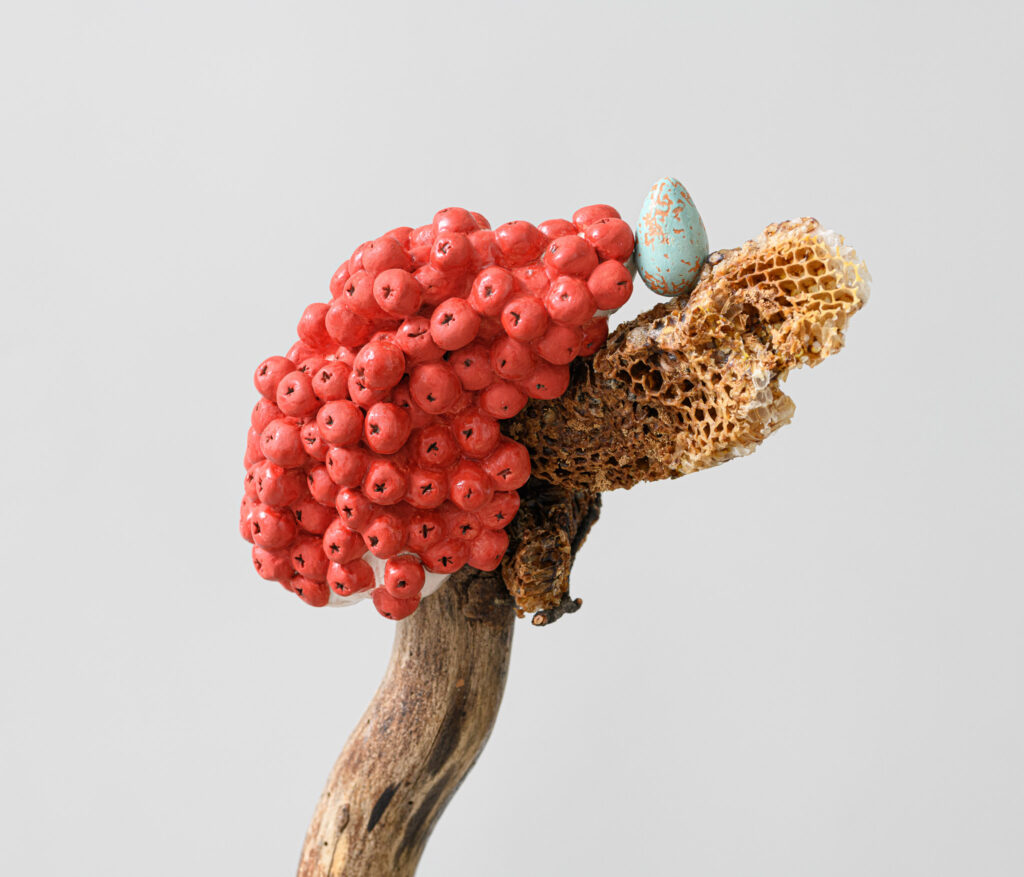
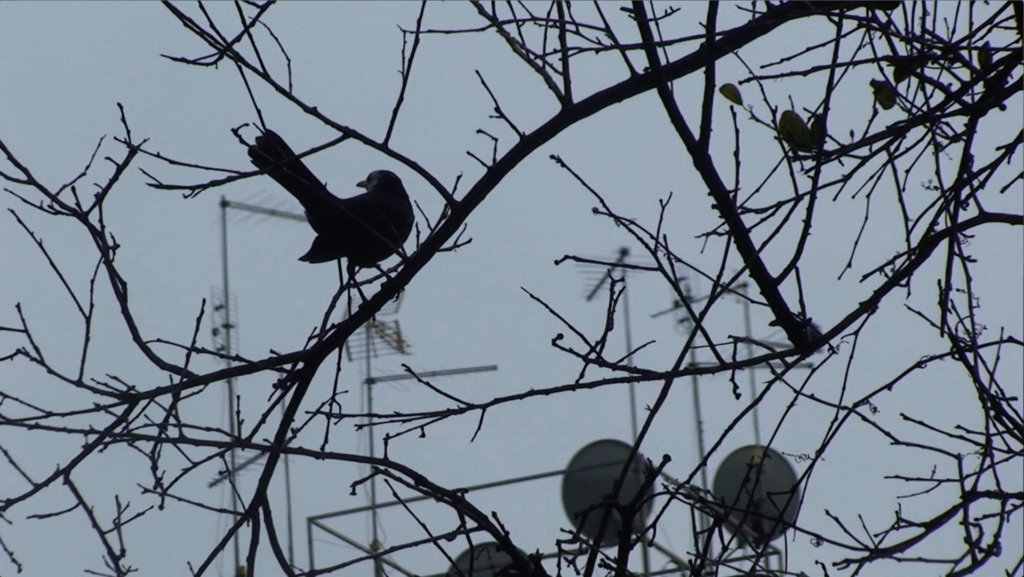
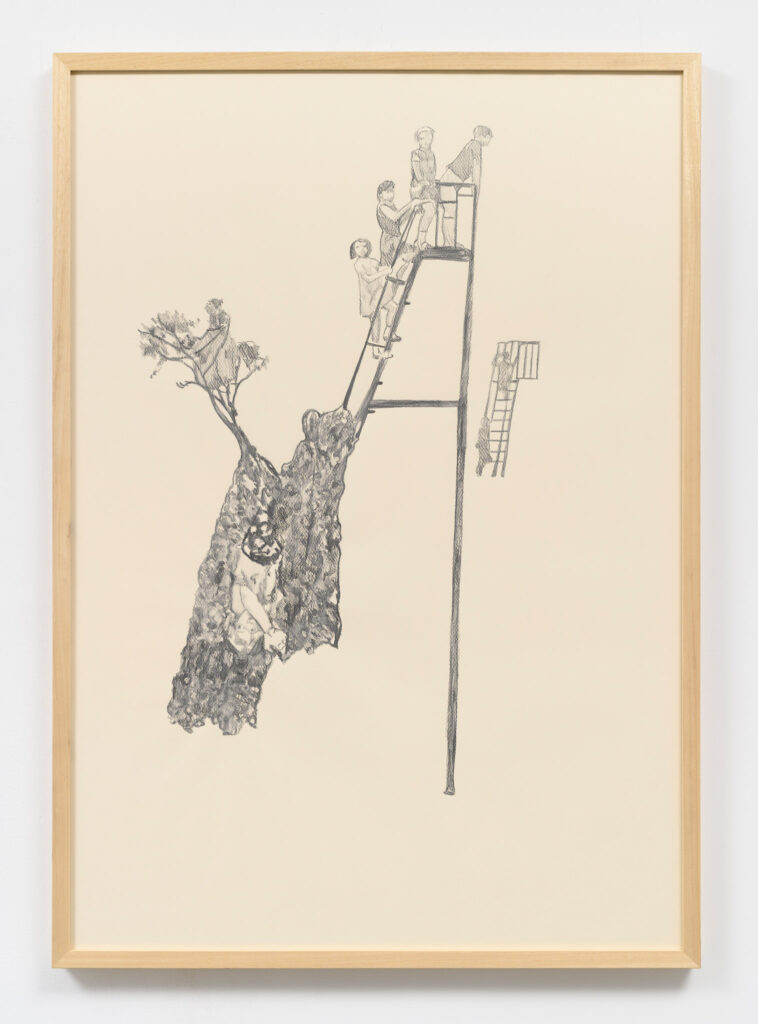
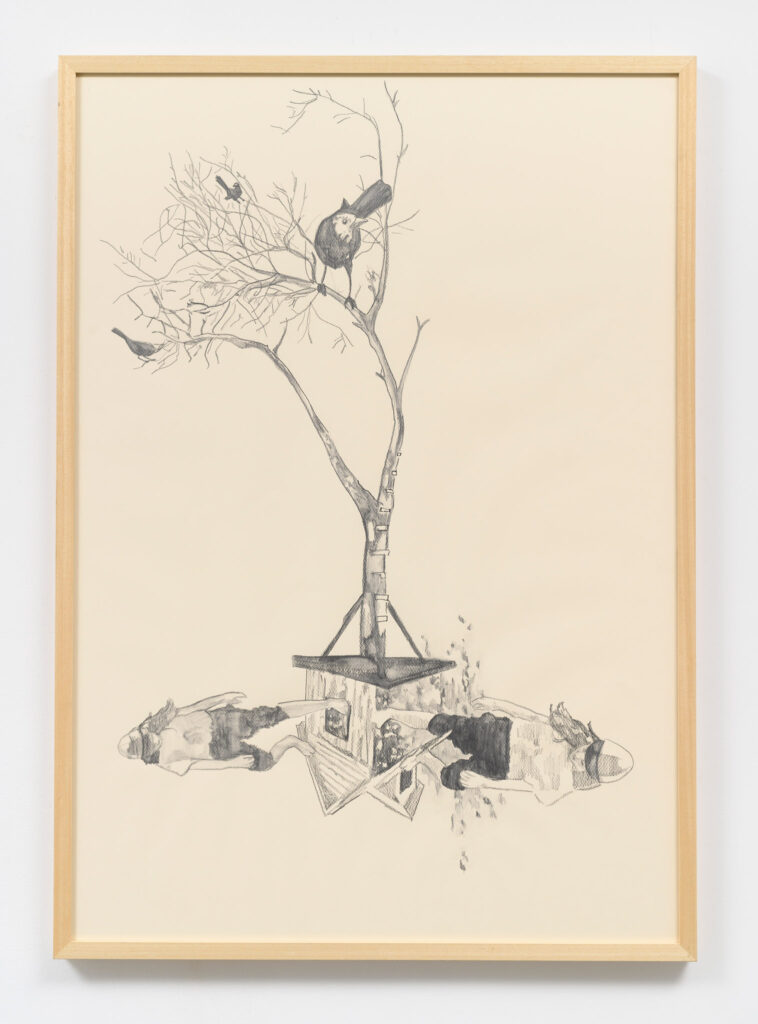
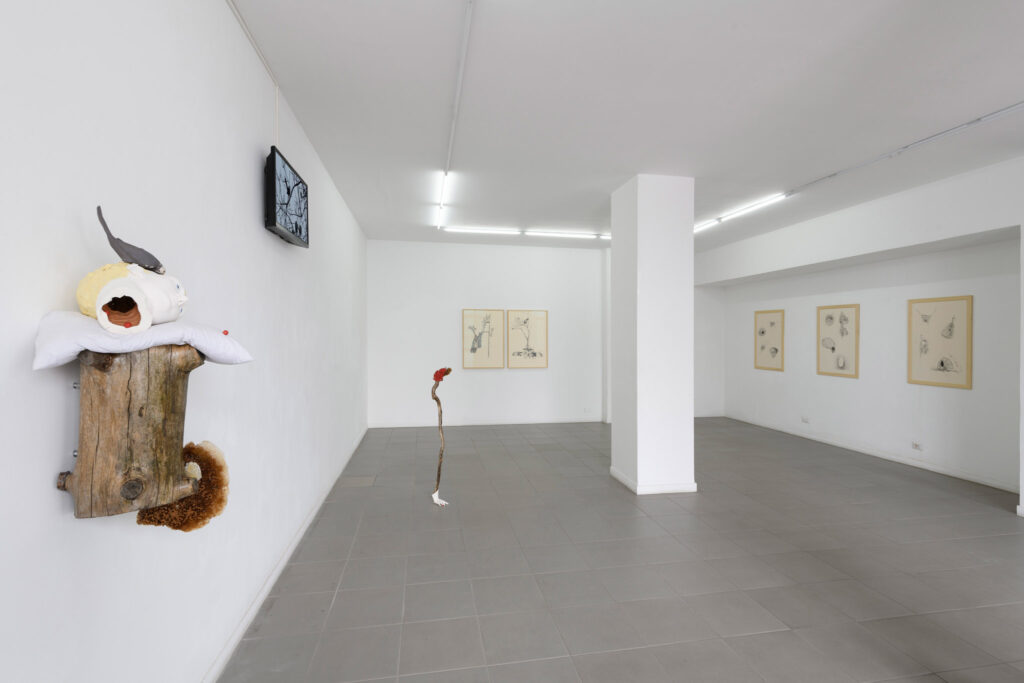
Luana Perilli takes a multidisciplinary approach by presenting a set of works ranging from ceramics and video. Inspired by the poem “The Treehouse” by James A. Emanuel, the artist identifies the treehouse as a physical and mental refuge, a return to childhood and adolescent gestations and transformations, a time of waiting. “To every man His house below And his house above With perilous stairs Between”: this is how Emanuel’s poetry ends, and Perilli wanted to walk those stairs, dialoguing with rare creatures such as the leucistic blackbeest, a natural anomaly bringing changes and magic that the artist has made the protagonist as well as other imaginary/real creatures of the forest that populate his multimedia intervention. The treehouse is also a reminder of that particular moment in adolescence when everything is a potential adamantine ready to exceed itself or give way to the squalor of the ordinary, at that moment of threshold that contains the concentration before the jump. It is reflecting on this that Perilli conceives the installation “Narcissus (portrait of the archangel Michael as a boy)”, inspired by the “Portrait of a Young Man” by Luca della Robbia and “Narcissus and Boccadoro” by Herman Hesse.

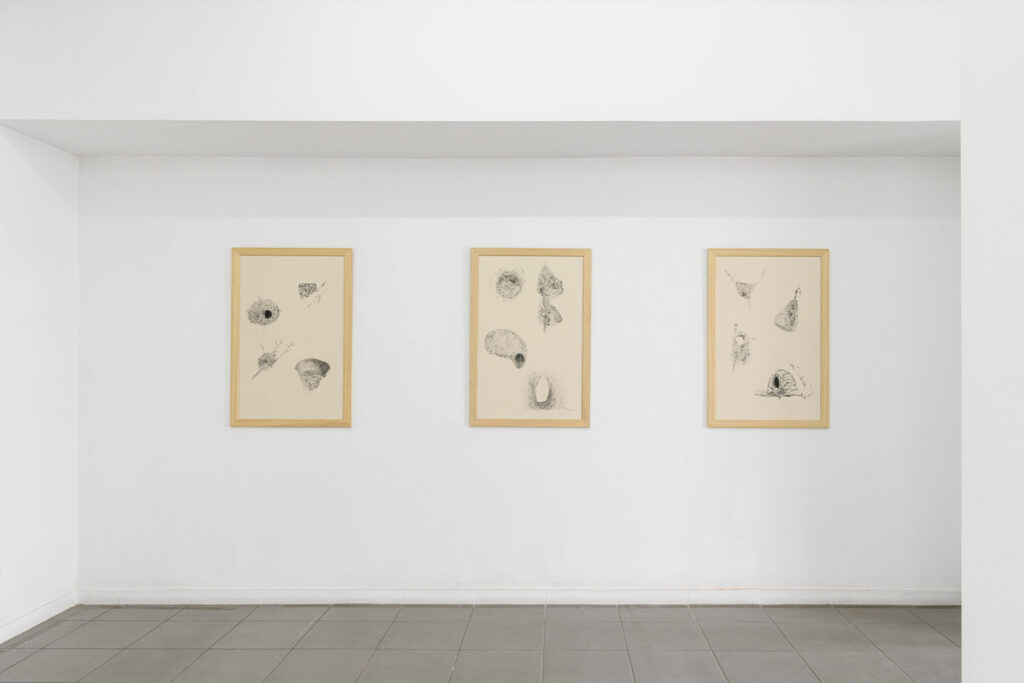
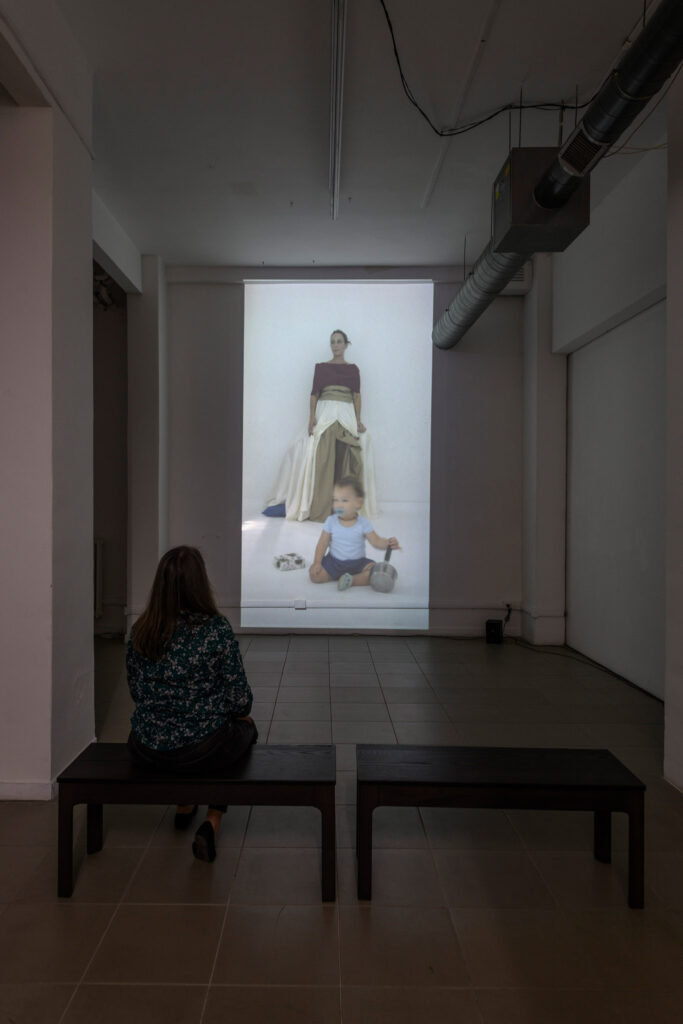
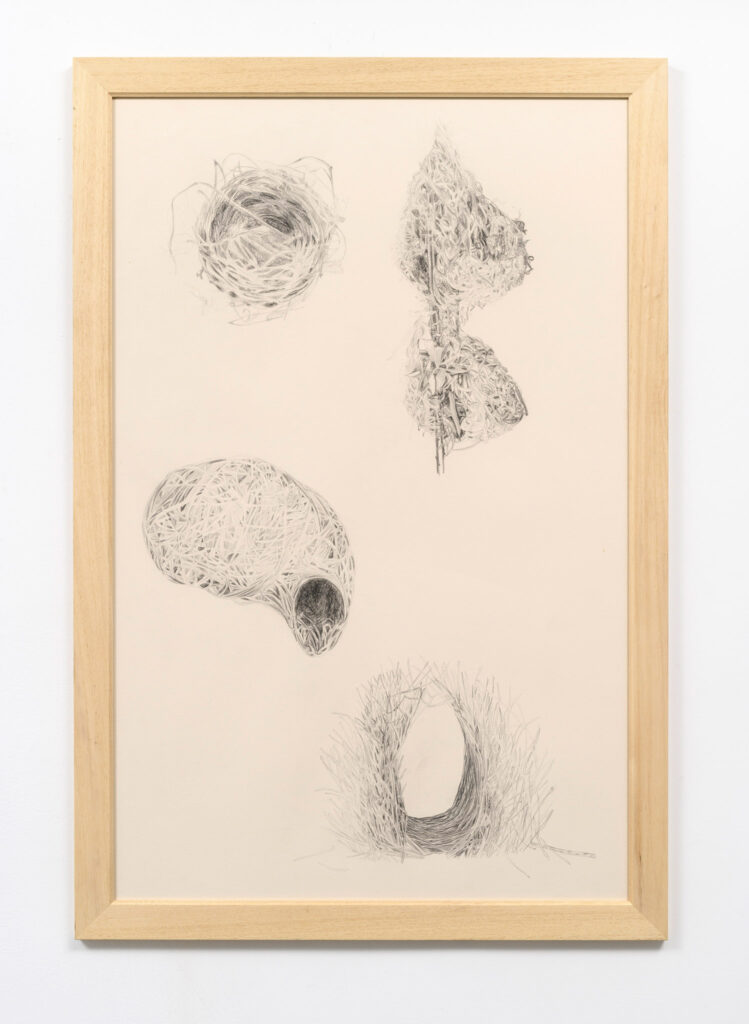
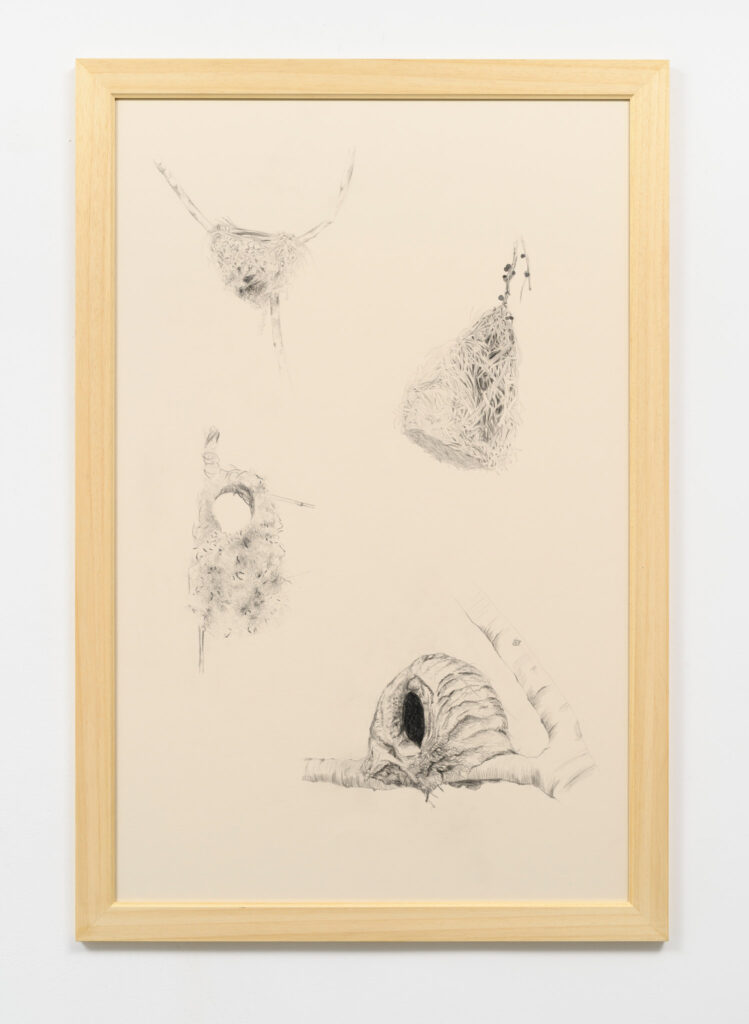
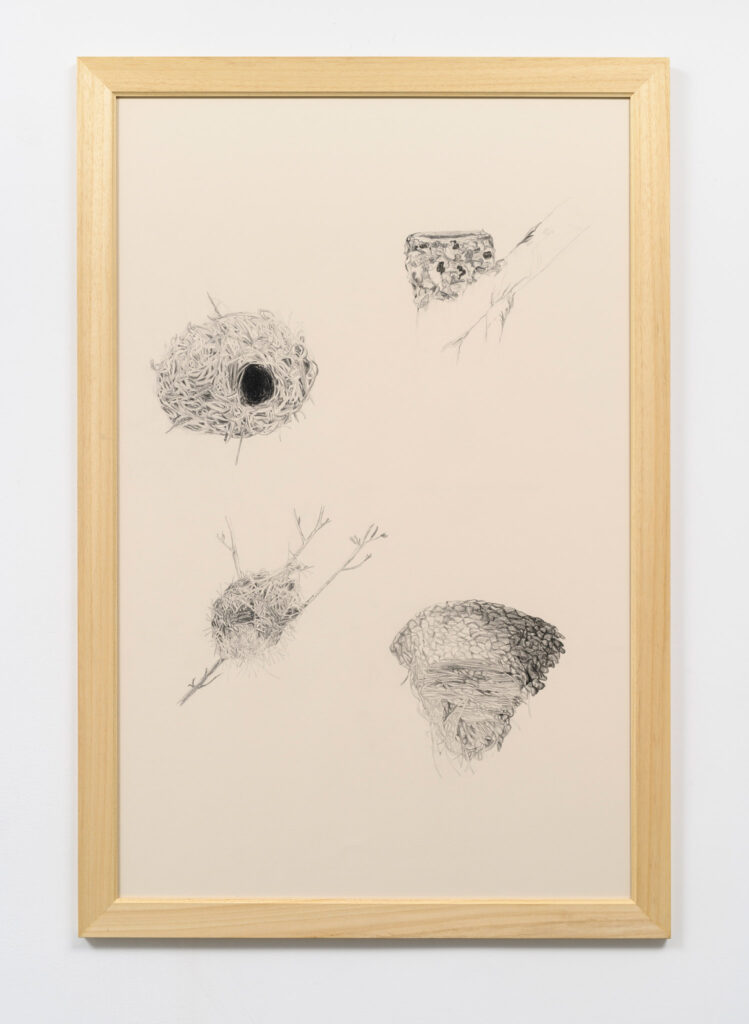
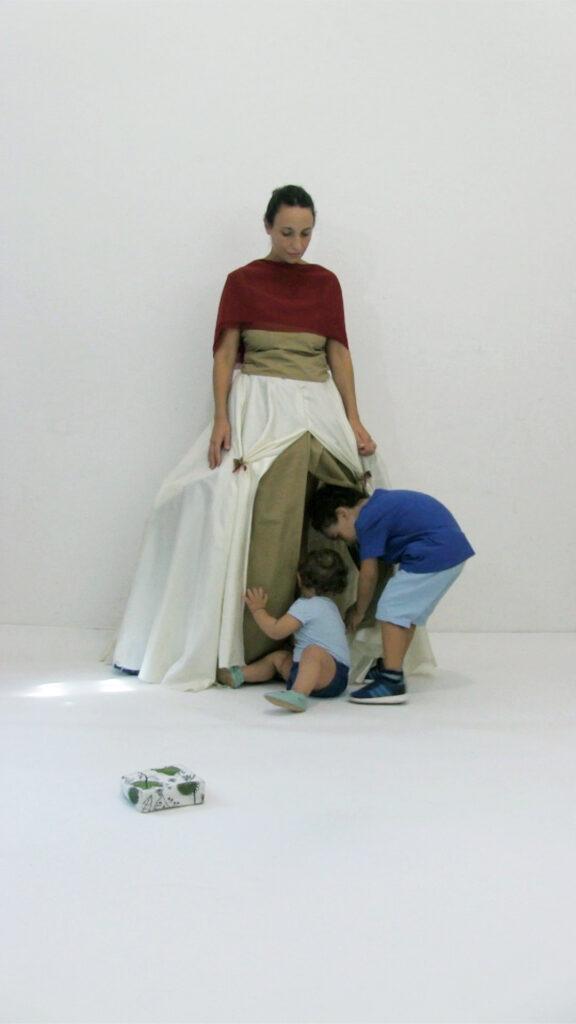
More aimed at the cultivation and protection of feelings is the interpretation of the living offered by Mariana Ferratto. The artist seems to provide a map of the places where spirituality is in, be they meticulously drawn small nests or a huge mother who becomes home for her cubs. In the video “Madame Maison” the installation dimension is functional to the use of the message: a gigantic woman interacting with children the size of adults, a woman motionless to denounce the paralyzing condition of women, even more so in the current pandemic situation. The imposing figure (the lady of the house) is clothed as an ancient lady and offers the central opening of her large skirt to the availability of two children who live there playing and simulating acts such as cooking, eating, sleeping, cleaning. In the choice of games, all projections of typically domestic activities, children elect their mother to the place of habitation. “Archive. An attempt to understand how to build a nest” is the title of the drawings that the artist has grouped on large sheets. These are meticulous designs, which reproduce leaves, small branches and mud with which each volatile species has built its own shelter. A slow and detailed work that the artist defines as a kind of mantra, to emphasise its dimension of welcome and refuge for one’s feelings.

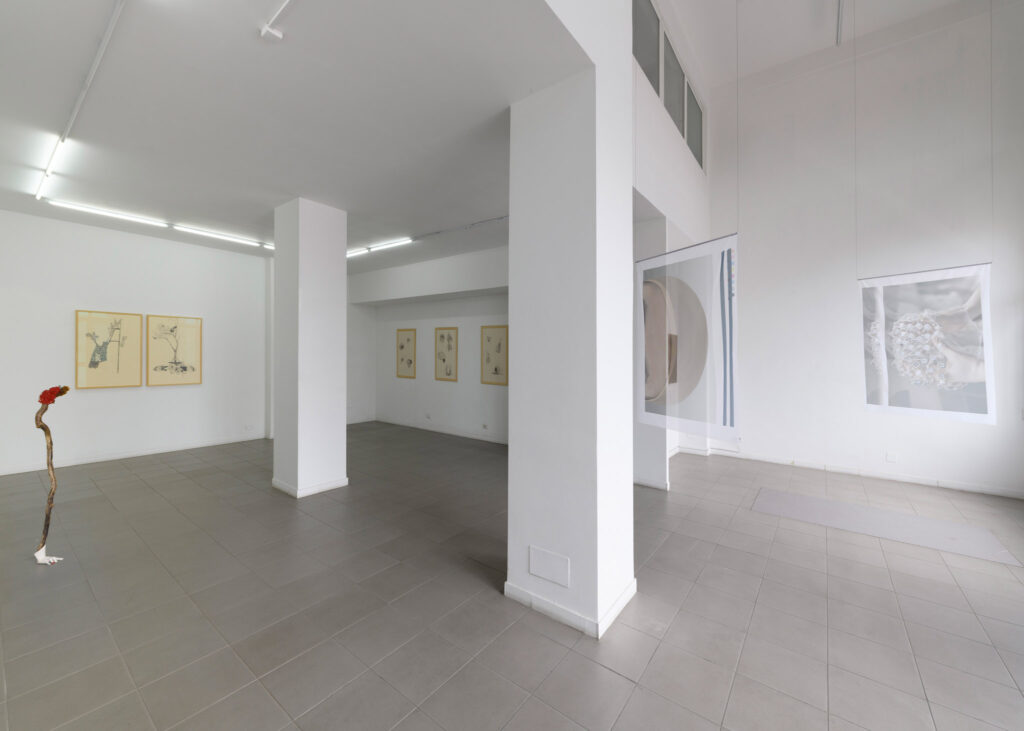
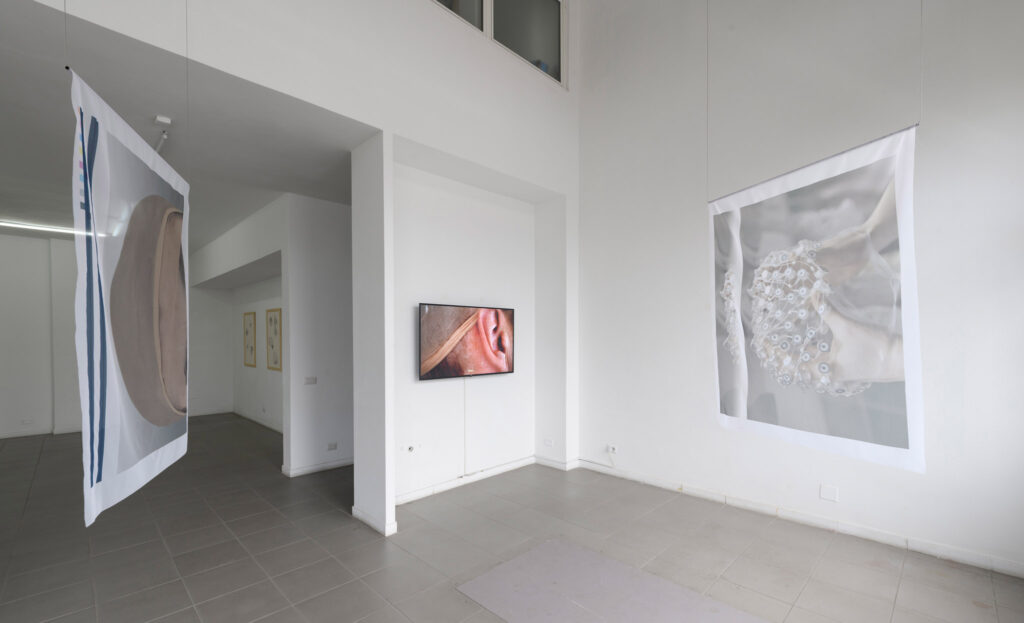
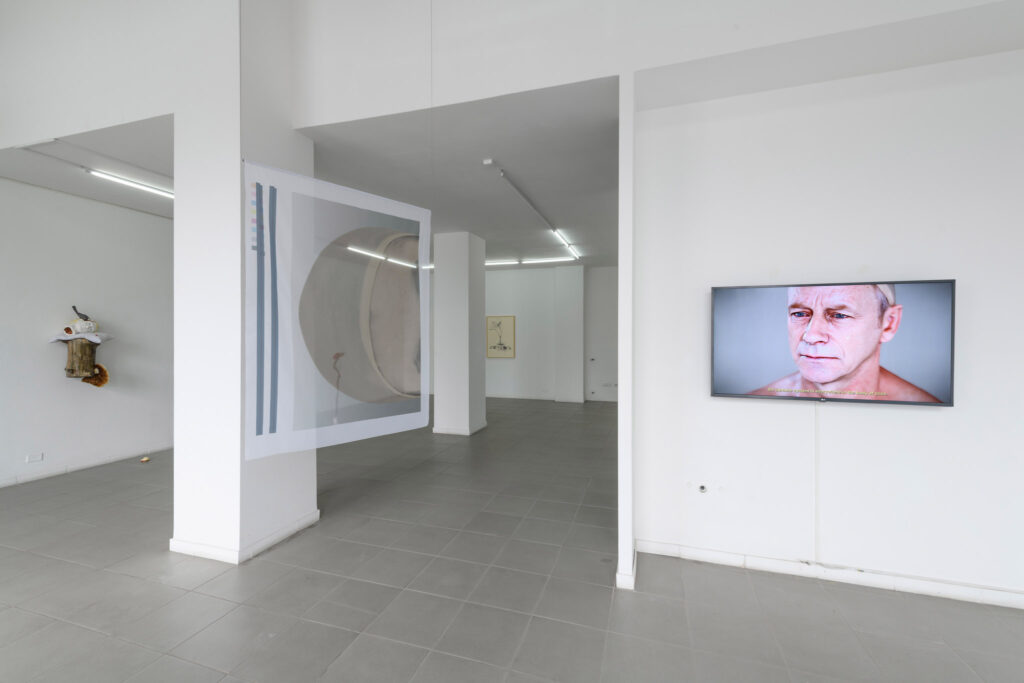
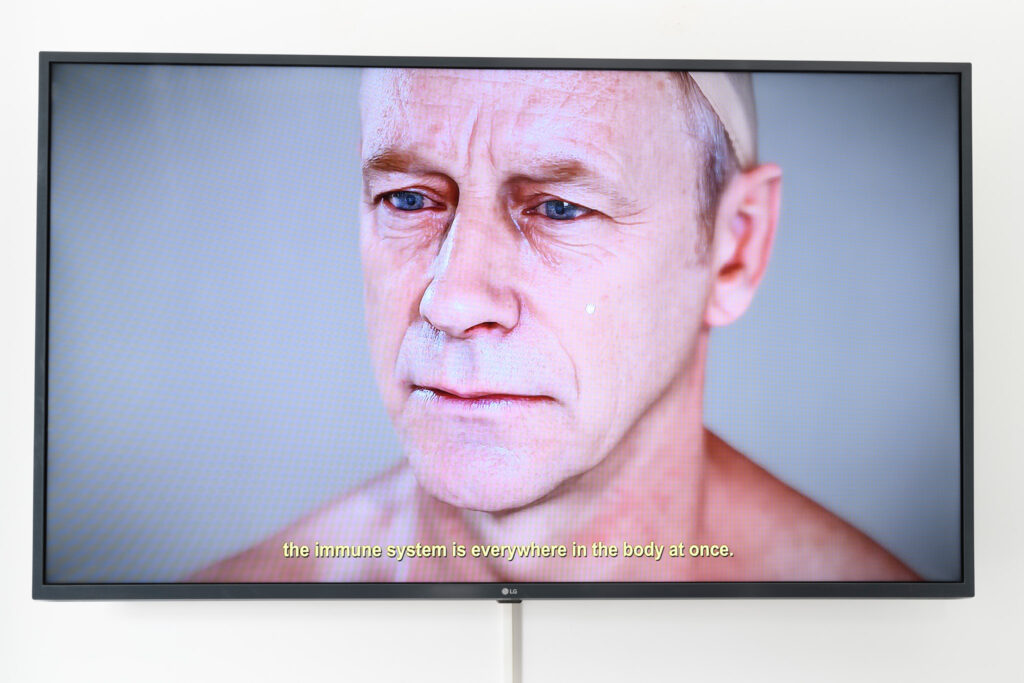
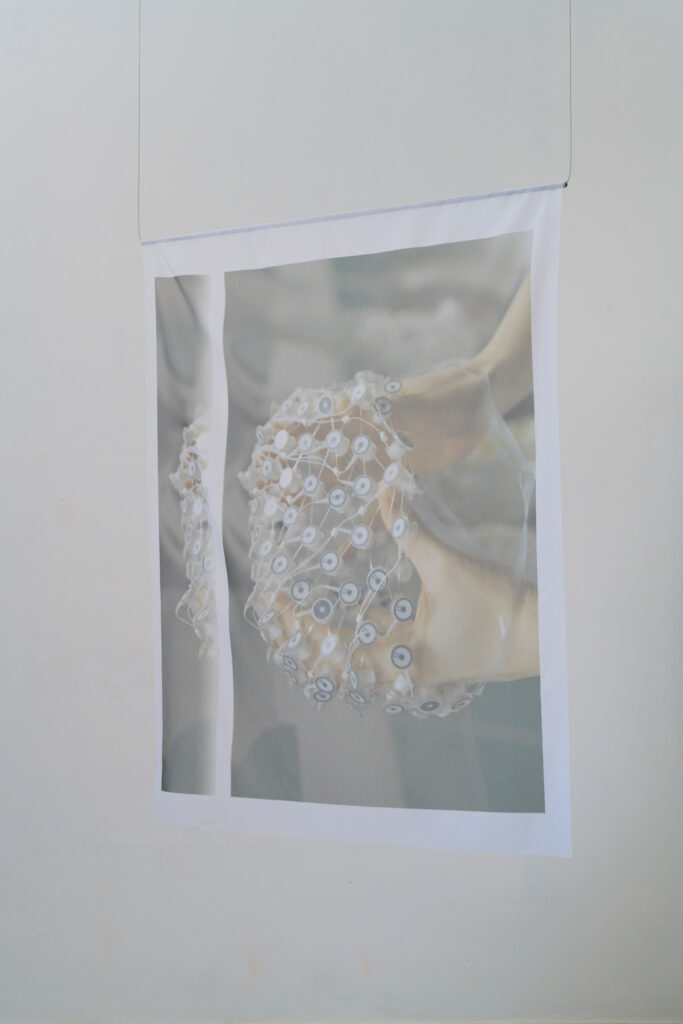
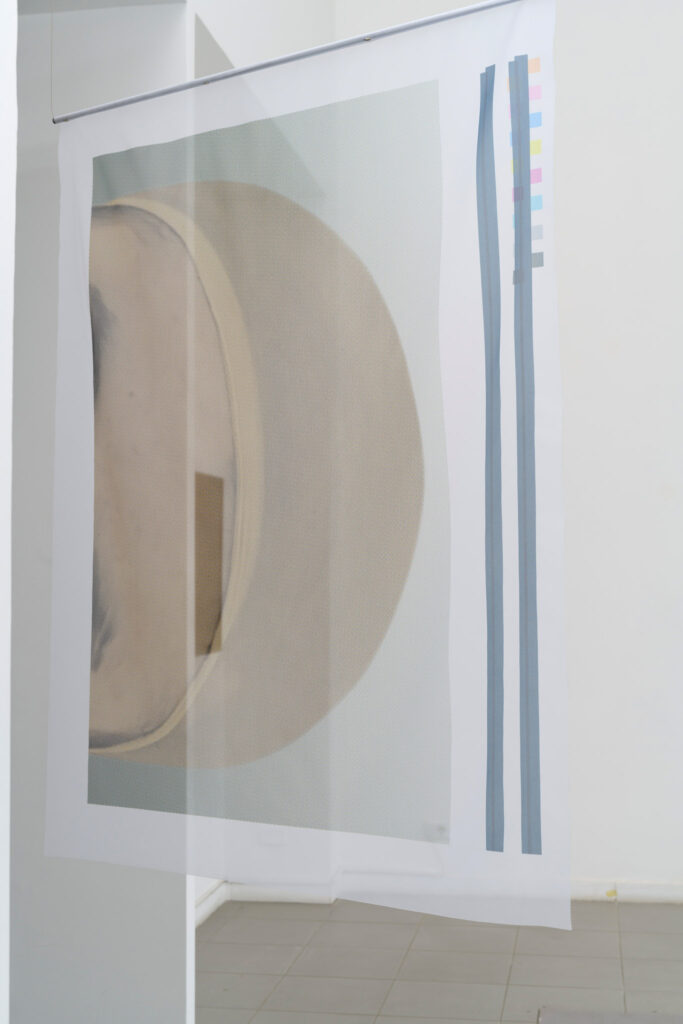
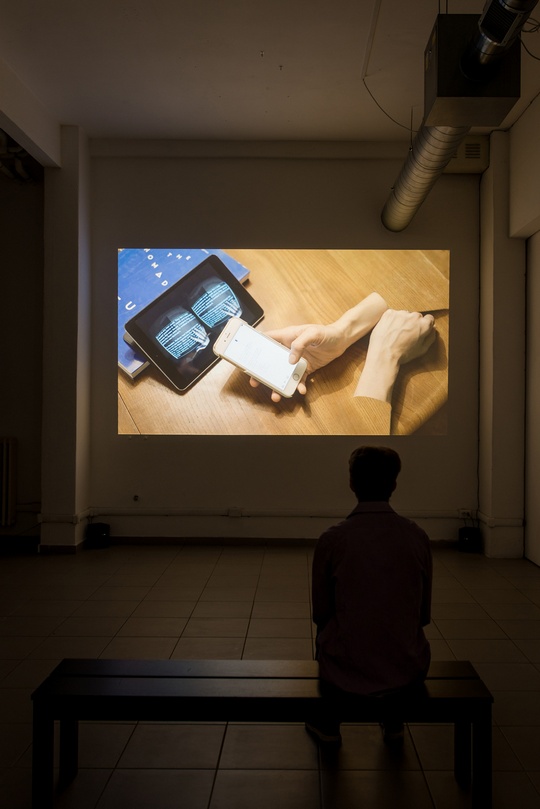
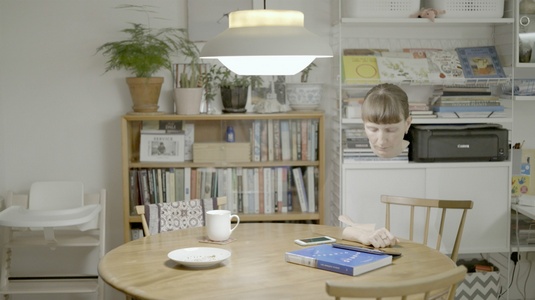
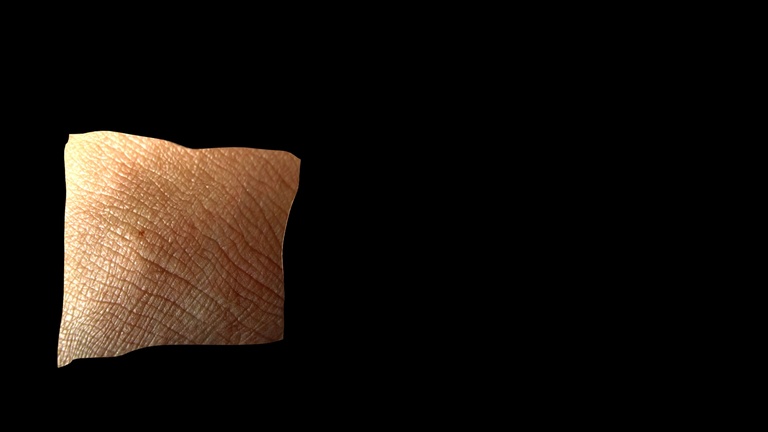
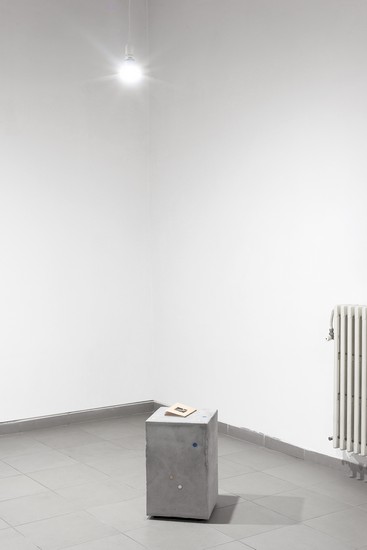
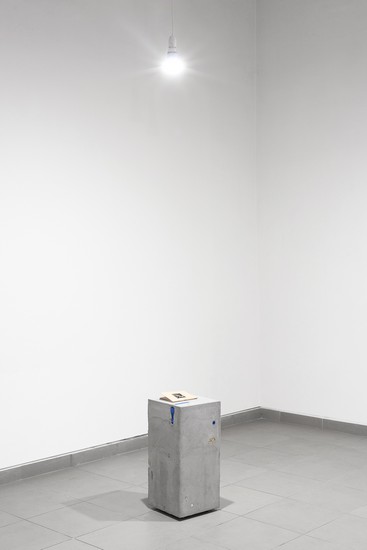
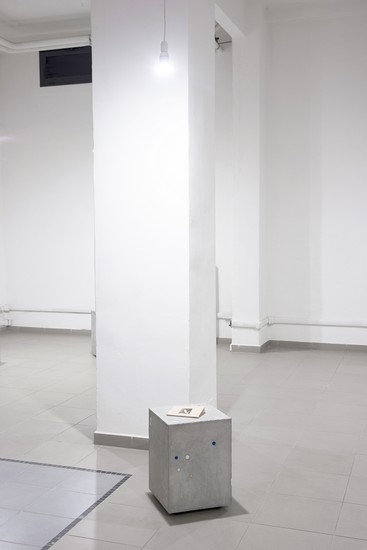
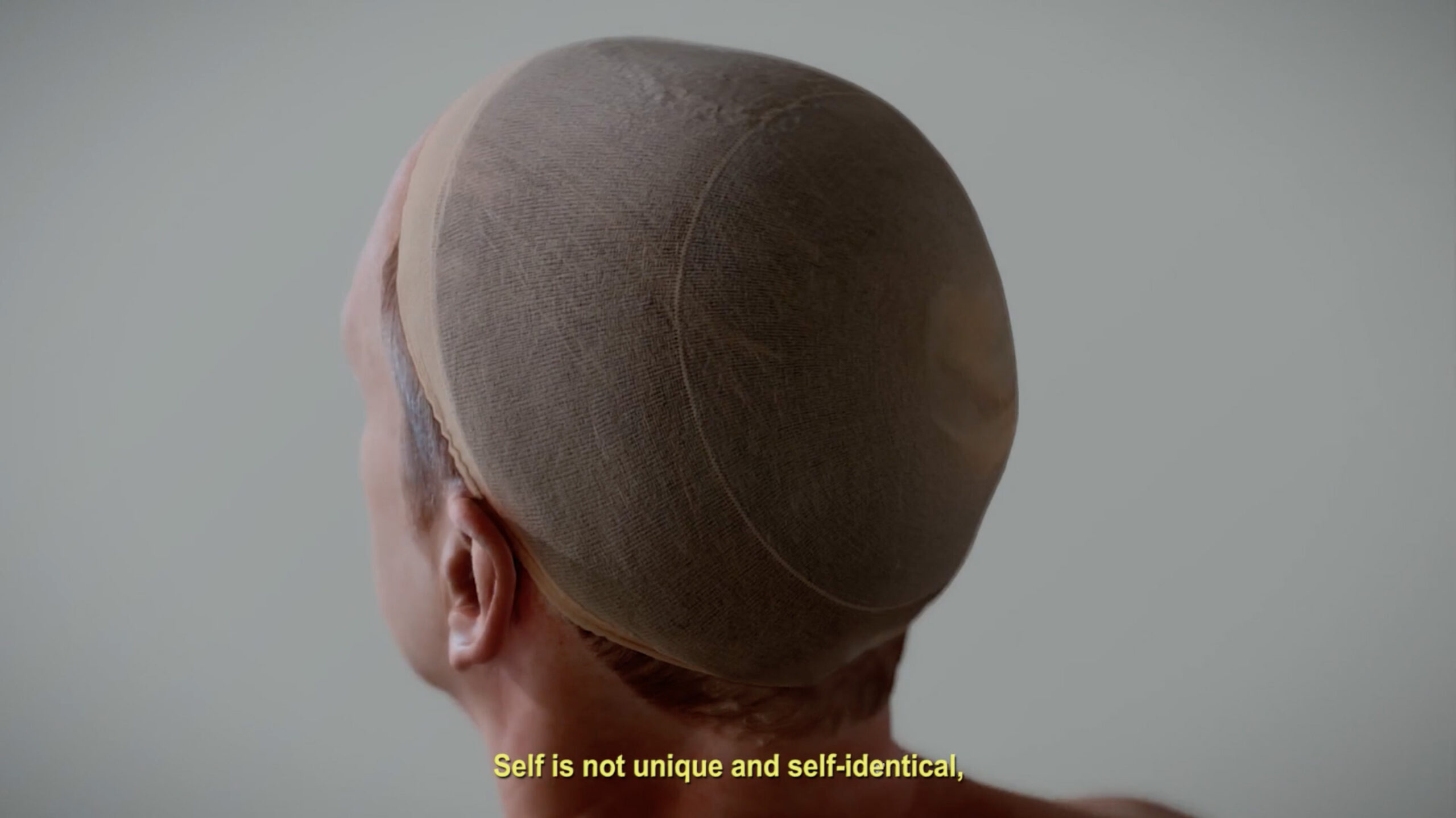
Finally, Rowena Harris offers her interpretation of living in terms of the human body, as that inhabited, situated and interactive with the material, social and political environment. The film “Molecular Multiplicities” is an inspection of the human as a body of visual, social and scientific construction. It playfully partners a realistic 3D scan of a middle-aged white man as a problematic ‘non-identity’ tied closely to dominant concepts of the human. A scientific narrative partners describing and troubling the self / other logic of the human immune system, and, though accounting its orifices, reveals the promise of the skin’s protection as a visual mirage. If the video provokes a problematised image of the body as a protective container from external agents, the installation “Waves and Waves” jostles the viewer into invisible interaction with the work. Viewing takes place with the flow of air and movement of other bodies, as the two silk images gently dance a dialogue about their invisible relation in space and in life – of the medical technology that comes to understand a mind and vice versa, in ways that maybe ineffable and of a knowledge that is embodied.

Ogni epoca storica presenta snodi capaci di polarizzare l’attenzione dell’opinione pubblica e lo sforzo intellettuale di chi è chiamato, nel bene o nel male, ad influenzarla. Sono grandi temi che arrivano a maturazione dopo lunga incubazione o che si manifestano in tutta la loro repentina urgenza quali effetti dell’uso virtuoso o scellerato delle nuove tecnologie. Scenari più o meno inaspettati rispetto ai quali ci si scontra, ci si arrovella, ci si aggroviglia fino a che si trovano soluzioni che consentono all’umanità di progredire o viceversa di esserne travolta.

Fra le tematiche che qualificano l’attuale fase storica a livello planetario, tre assumono oggettivamente il rilievo massimo: le migrazioni, la pandemia, i cambiamenti climatici. Ciascuno di questi temi è un mondo a sé, con infinite sfaccettature, implicazioni e conseguenze. Sono questioni che influenzano fortemente il rapporto tra l’umanità e il pianeta che la accoglie, determinando regole, modalità e qualità dell’abitare il mondo. I lavori di Mariana Ferratto, Rowena Harris e Luana Perilli riuniti nella mostra DIMORE ne propongono una chiave di lettura parziale ma omogenea seppure nella diversità delle rispettive ricerche, della scelta dei media e dei contenuti trasmessi.

Le tre artiste scandagliano la dimensione del dimorare da angolazioni diverse, non ricercandone i risvolti intimi e domestici, al contrario evidenziando il rapporto tra il sé e l’ambiente che ci circonda e ci contiene. Dimora è quindi l’habitat con cui entriamo, volenti o nolenti, in contatto e con le cui necessità dobbiamo fare i conti, perché la natura ci sarà sempre anche se e quando non ci sarà più l’uomo. Dimora è la dimensione affettiva, spirituale, le persone che ci sono più vicine e con cui condividiamo spazio fisico e mentale, siano esse i nostri affetti più cari o estranei che dobbiamo accogliere in nome di un sentimento tutto da costruire e che ancora non è stato nominato, un’accoglienza che parta dall’inadeguatezza del concetto stesso di migrante, che sottintende un libero arbitrio in realtà inesistente. Abitare la propria pelle significa parlare del corpo umano come meccanismo apparentemente chiuso e perfetto che ci fornisce un senso di totale affidabilità e protezione, pur essendo invece, a diverse scale, poroso per definizione a causa dei suoi numerosi orifizi e delle interazioni del sistema immunitario con l’ambiente

Luana Perilli adotta un approccio multidisciplinare presentando un insieme di lavori che spaziano tra ceramica e video. Ispirandosi alla poesia The Treehouse di James A. Emanuel, l’artista individua nella casa sull’albero un rifugio fisico e mentale, un ritorno alle gestazioni e trasformazioni infantili e adolescenziali, un tempo di attesa. Ad ogni uomo la sua casa sotto e la sua casa sopra, in mezzo scale pericolose: così termina la poesia di Emanuel e Perilli ha voluto percorrere quelle scale, dialogando con creature rare come il merlo leucistico, anomalia naturale portatrice di cambiamenti e magie che l’artista ha reso protagonista al pari di altre creature immaginarie/reali del bosco che popolano il suo intervento multimediale. La casa sull’albero è anche un richiamo a quel particolare momento dell’adolescenza in cui tutto è un potenziale adamantino pronto ad eccedere se stesso o cedere il passo allo squallore dell’ordinario, a quel momento di soglia che contiene la concentrazione prima del salto. E’ riflettendo su questo che Perilli concepisce l’installazione “Narciso (ritratto dell’arcangelo Michele da adolescente), ispirato al “Ritratto di giovinetto” di Luca della Robbia e a “Narciso e Boccadoro” di Herman Hesse.

Più rivolta alla coltivazione e protezione dei sentimenti è l’interpretazione dell’abitare offerta da Mariana Ferratto. L’artista sembra fornire una mappa dei luoghi in cui alberga la spiritualità, siano essi dei piccoli nidi minuziosamente disegnati o una madre enorme che diventa casa per i suoi cuccioli. Nel video “Madame Maison” la dimensione installativa è funzionale alla fruizione del messaggio: una donna gigantesca che interagisce con bambini dalle dimensioni di adulti, una donna immobile a denunciare la paralizzante condizione femminile, ancor più nell’attuale congiuntura pandemica. L’imponente figura (la signora della casa) è abbigliata da antica dama ed offre l’apertura centrale della sua grande gonna alla disponibilità di due bambini che la abitano giocando e simulando atti come cucinare, mangiare, dormire, pulire. Nella scelta dei giochi, tutte proiezioni di attività tipicamente domestiche, i bambini eleggono la loro madre a luogo di abitazione. “Archivio. Tentativo di capire come si costruisce un nido” è il titolo dei disegni che l’artista ha raggruppato su grandi fogli. Si tratta di disegni minuziosi, che riproducono foglie, piccoli rami e fango con cui ciascuna specie volatile ha costruito il proprio rifugio. Un lavoro lento e dettagliato che l’artista definisce come una sorta di mantra, a sottolinearne la dimensione di accoglienza e rifugio per i propri sentimenti.

Infine, Rowena Harris offre la sua interpretazione dell’abitare: un corpo abitato e che abita, un corpo situato e interattivo con l’ambiente materiale, sociale e politico. Il film “Molecular Multiplicities” è un’ispezione dell’umano come costruzione visiva, sociale e scientifica. L’immagine è associata ad una scansione 3D realistica di un uomo bianco di mezza età, una “non identità” problematica strettamente legata a concetti dominanti per l’umano. Un partner narrativo scientifico che descrive e interroga la logica del confronto tra il sé e l’altro propria del sistema immunitario umano e, pur contabilizzando i suoi orifizi, rivela la promessa della protezione della pelle come un semplice miraggio. Se il video provoca un’immagine problematizzata del corpo come contenitore protettivo da agenti esterni, l’installazione “Waves and Waves ” spinge lo spettatore all’interazione con l’opera. La visione è condizionata dal flusso dell’aria e dal movimento di altri corpi, mentre le due immagini stampate su seta danzano delicatamente dialogando sulla loro relazione invisibile nello spazio e nella vita – quella della tecnologia medica che arriva a comprendere una mente e viceversa, in modi forse ineffabili che incarnano la conoscenza.
SOFT BOUNDARIES

Rowena Harris

22.09.2017 – 22.12.2017

Exhibition Views

Works

Soft Boundaries describes the current state in which we live – a state where experiences, effects and understanding gained from the digital realm move freely into our tangible reality. Boundaries that may once have been neatly defined, are now soft and pliable – they are superficial membranes that positively support the act of osmosis between digital and material. The body is at the centre of Harris’ investigation into this area. Through considering the concept of ‘corporeal schema’ (or body image), which can be understood as the body’s capacity to be open to, and intertwined with the world, and where body image is not fixed or rigid but adaptable to the myriad of tools and technologies that may be embodied[i], she considers the contemporary body as one not limited by the boundary of our skin – our bodies have become media and media are reconfiguring our matter[ii].
Can our everyday technologies alter our perception of touch? – our perception of materiality? – our perception of where the limits of our own bodies lie?

The exhibition interprets these question poetically, perhaps phenomenologically, as a brief moment when bodily perception suddenly goes awry. Akin to sitting but the seat is lower than you expect; to expecting an extra step ascending or descending stairs; when you expect the ground to be hard but it is soft beneath your feet. Being subject to a soft boundary is akin to falling when you least expect.

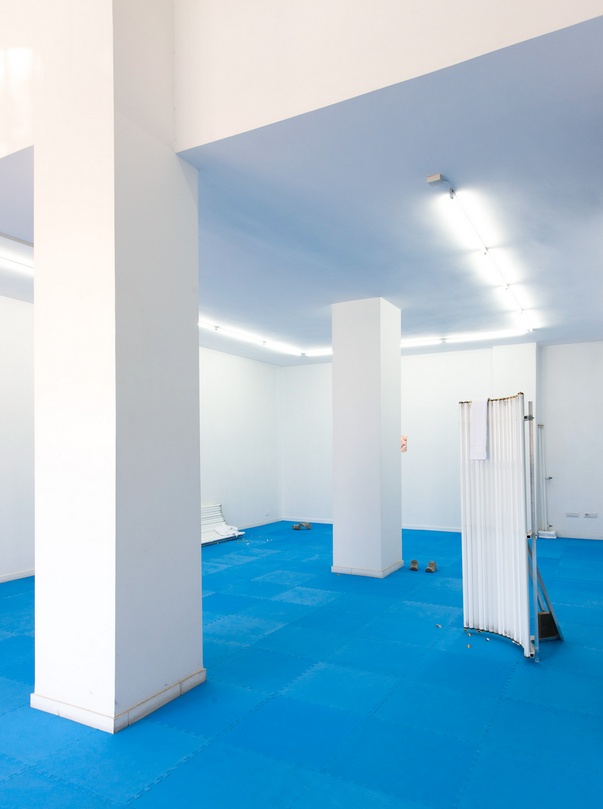
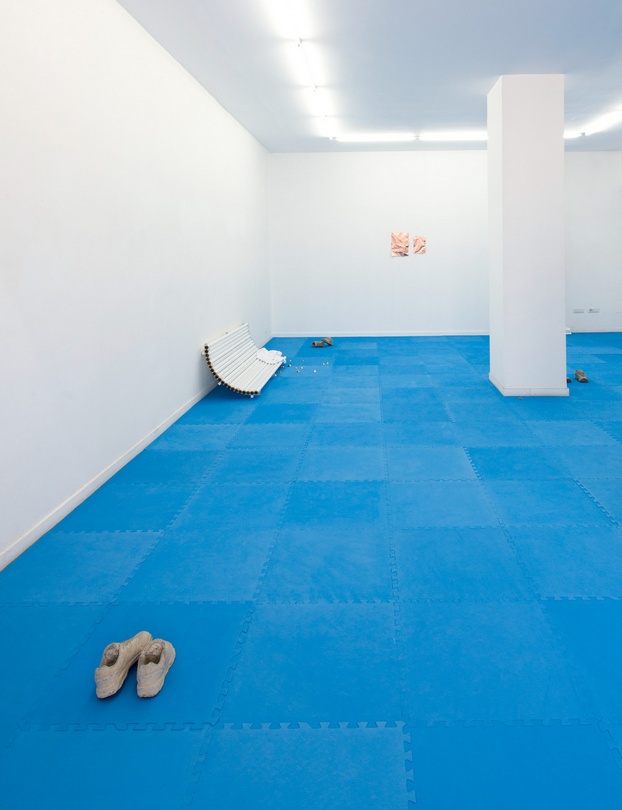
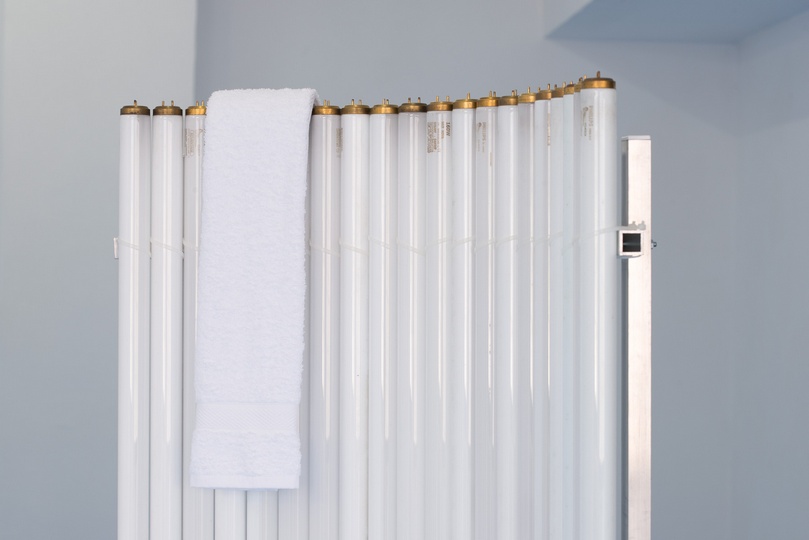
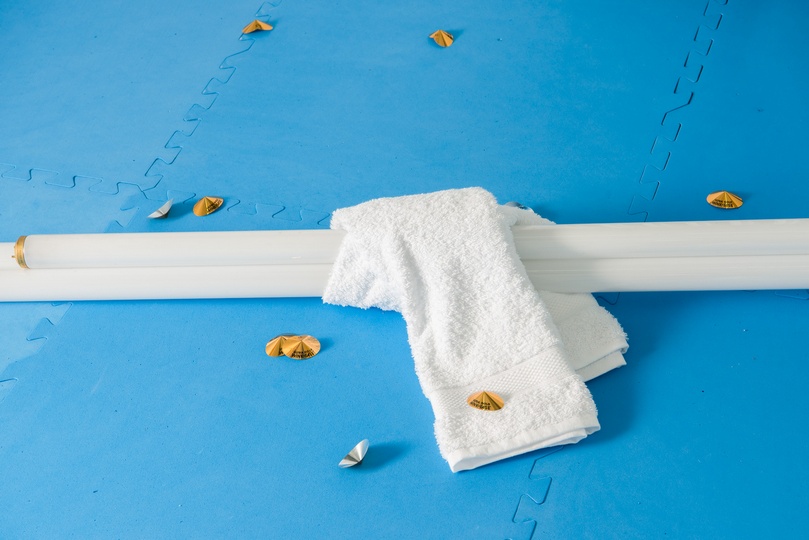
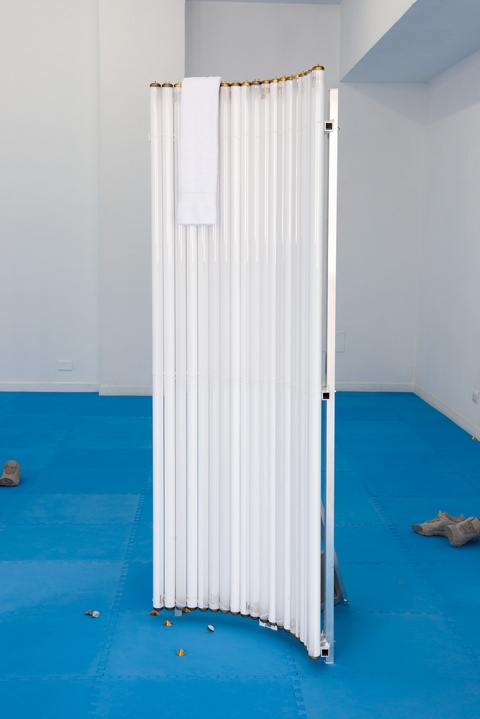
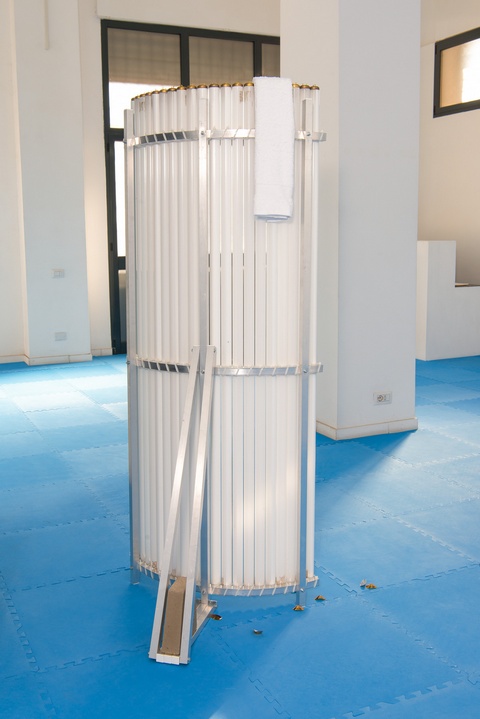
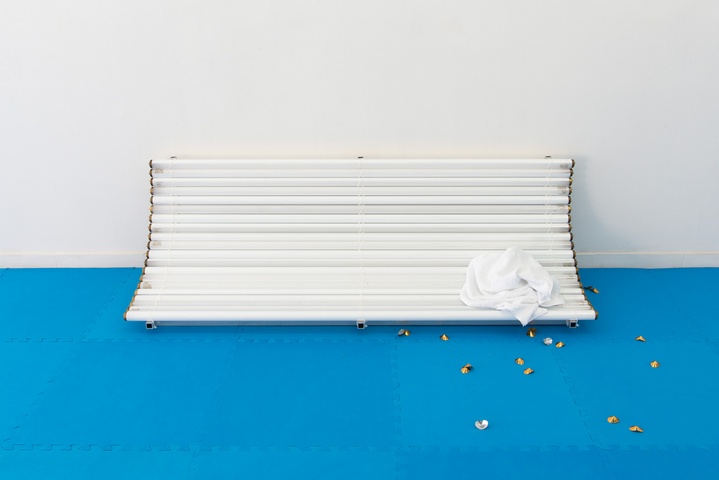
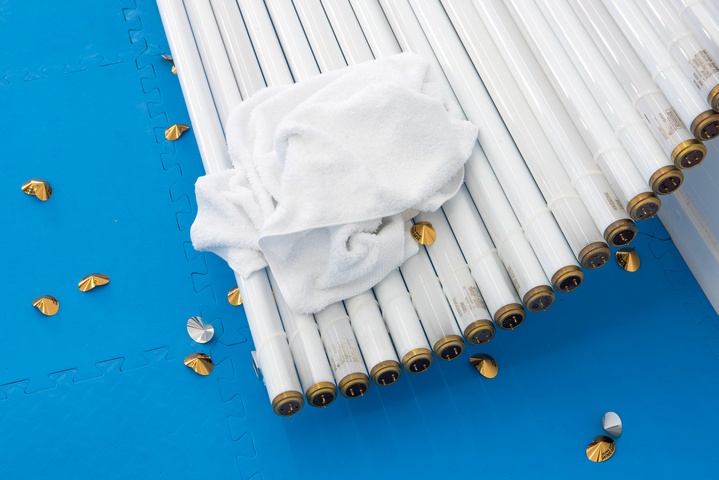
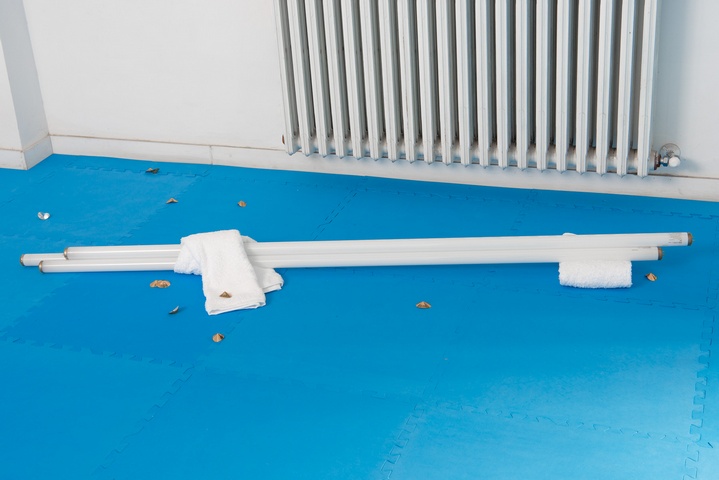
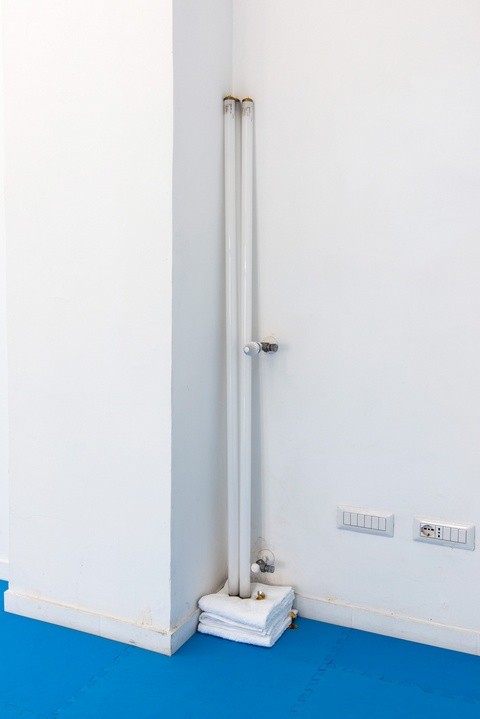
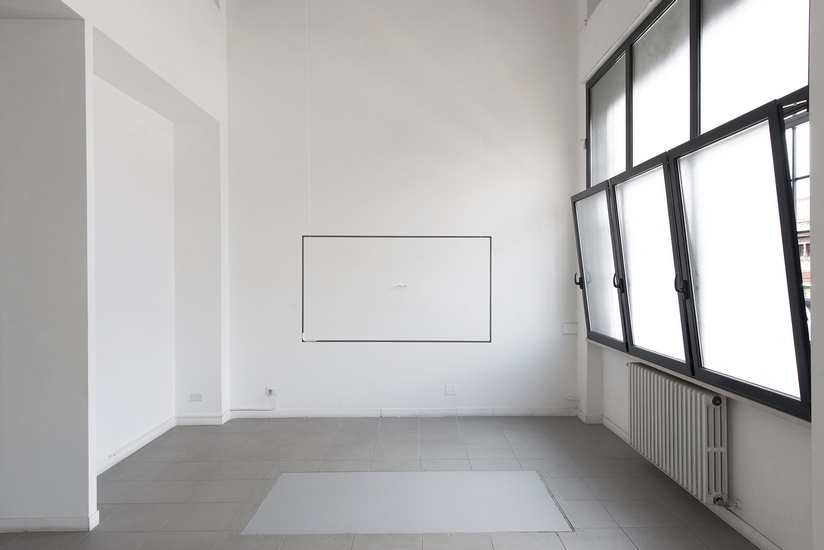
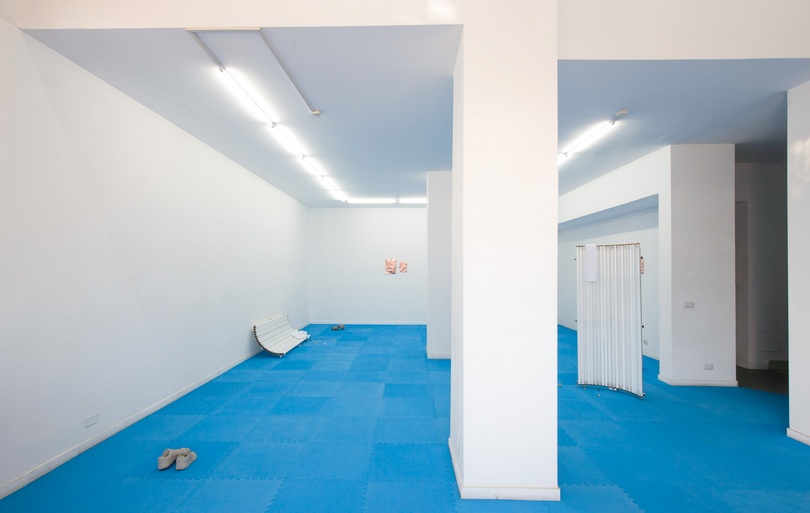
Harris’ practice is informed by the murky area between materiality and digitality, considered from the site of the human body, and her work spans both sculpture and digital forms. In the exhibition, she calls the viewers own body into the question through an experiential element – a soft foam flooring that gives beneath one’s feet. She also introduces the idea of skin as a phantom presence, through sculptures ‘Golden Brown Texture Like Sun’ that are comprised of used and expired sun tanning bulbs – bulbs which have acted upon countless human bodies – transferring UV rays into their skin. These ‘countless skins’ become veritable ghosts in the exhibition, and golden, cone shaped eye protectors that are a noticeable feature of tanning salons, litter the gallery floor.

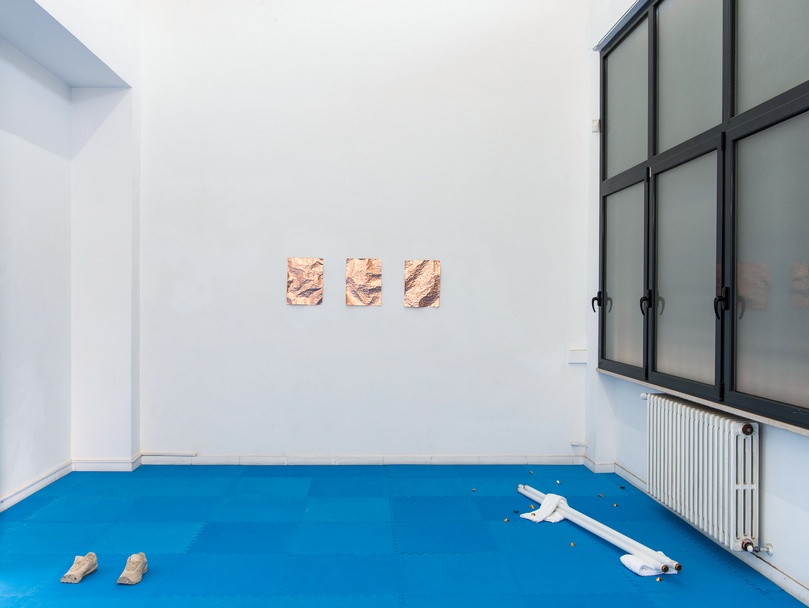
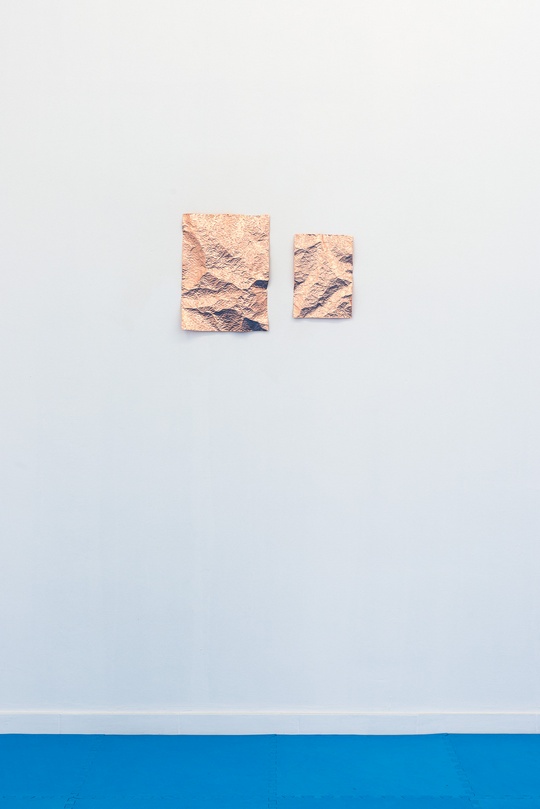
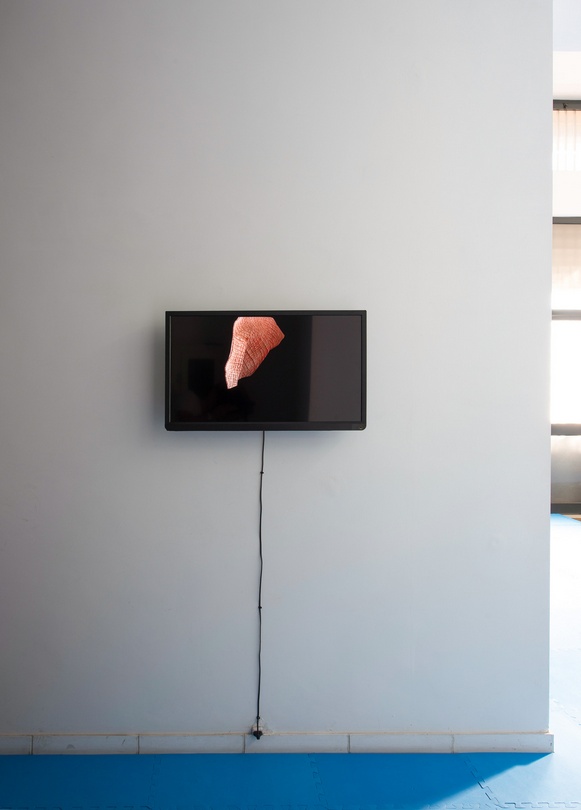
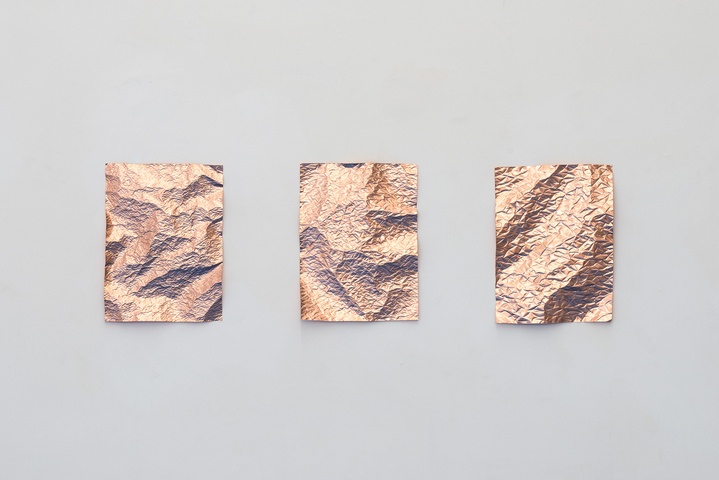
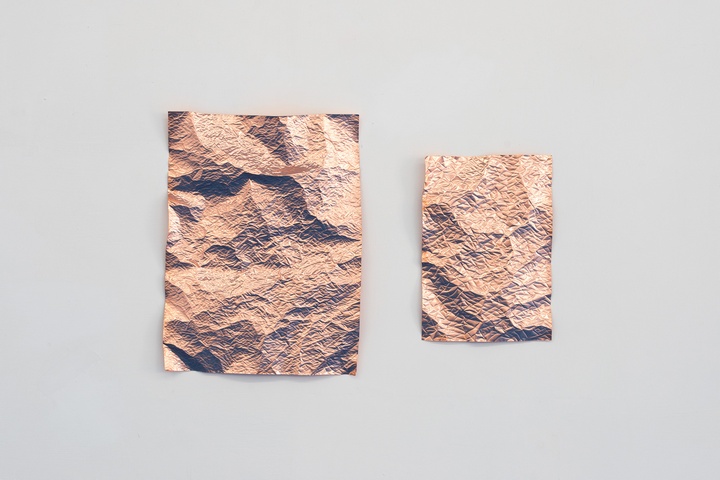
The series ‘Pelts’ comprised of thin copper surfaces, alongside a film in the basement also titled ‘Pelt’, focuses on digital rendering of skin, where skin, in 3D modelling as well as 3D printing (colloquially called ‘pelts’ or (animal) hides, by programers), is nothing other than pure surface – depth is rendered as an illusion as pixels in a jpeg, and wrapped like a blanket on a digital 3D form. In the sculptural works, Harris imagines a conversion through embossing the jpeg into a surface, creating works that slip between surface and three-dimensional form.

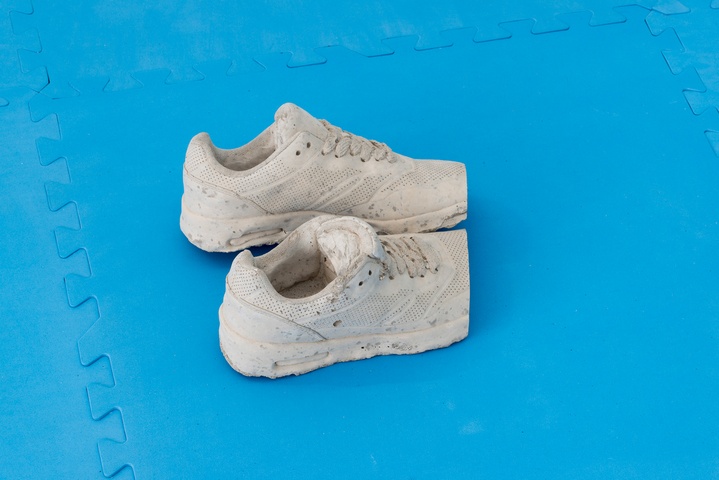
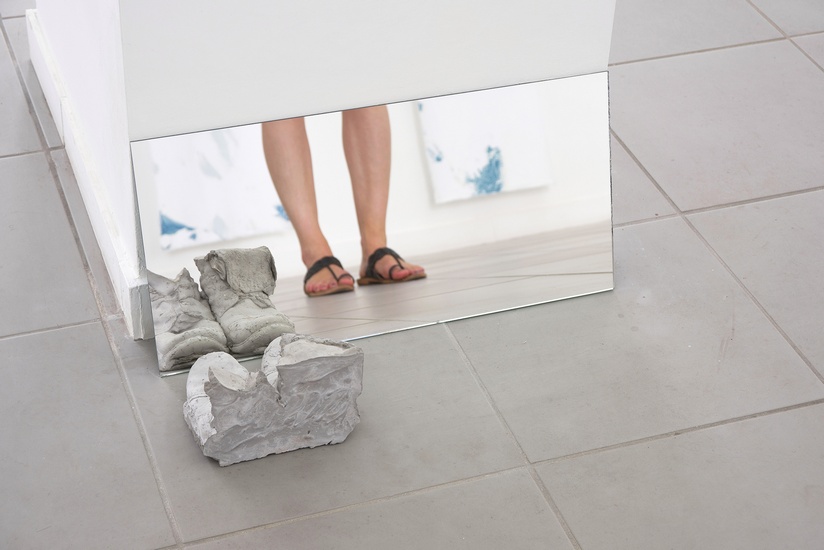
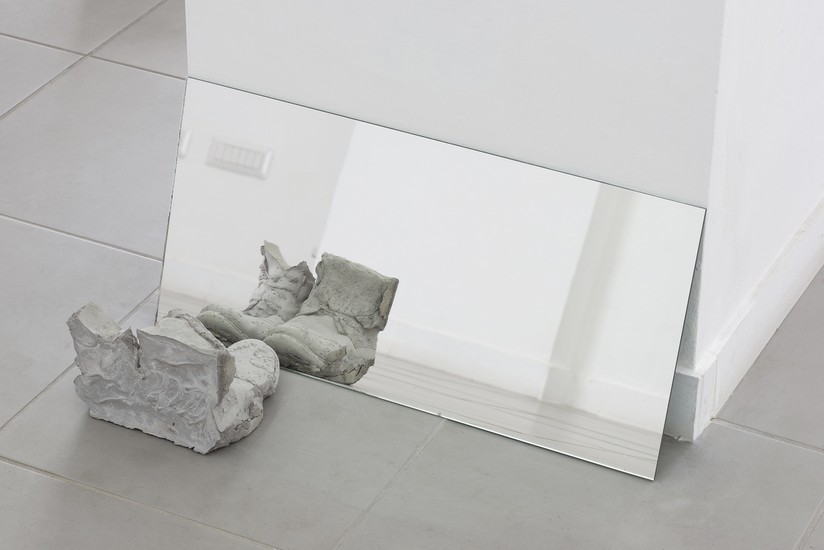
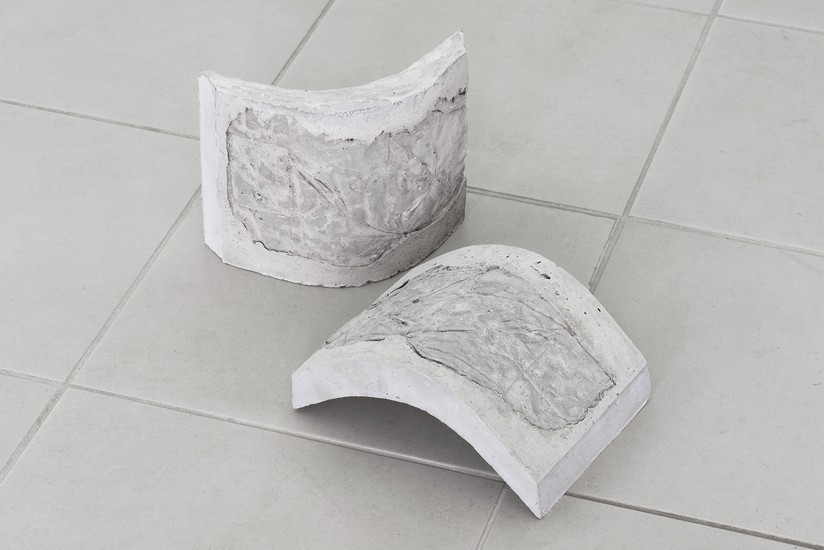
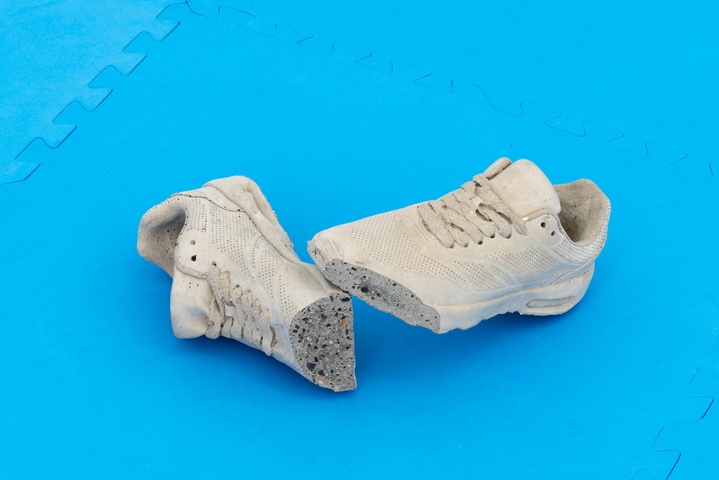
The sculptural series ‘At the Edge of the Frame’, which are cast concrete shoes, Harris has applied a digital gesture of ‘cropping’, familiar from Photoshop, Instagram and similar, to material form. One clean line dissects each pair of shoes, and through this she creates a form that plays with our familiar understanding of digital imagery, whilst with the same gesture, reveals the sculptures solid concrete interior and their brutal ‘there-ness’ of matter.

In the basement of the gallery the film ‘A room within which the computer can control the existence of matter’ takes it’s title from a quote by Ivan Sutherland, creator of the first virtual reality (VR) machine. The film considers the potentiality of digital experience to reform how we understand our own human body. It combines research on ‘corporeal schema’ – embodiment within virtual reality – and Harris’ long-standing interest in virtual phantom limb therapy (VPLT)[iii], and probes whether our digital experiences could be considered in the same vein as that of VPLT and VR embodiment experiments in altering our perception of our bodily state, but rather subsumed and unnoticed as part of our everyday reality.

[1] 1994, E. Grosz, Volatile Bodies: Toward a Corporeal Feminism, Allen & Unwin, AU

[1] 2015, J. Laia, Hybridze or Disappear, Mousse Publishing, Milan, IT

[1] VLPT or Virtual Phantom Limb Therapy, is given to amputees to relieve pain in a phantom limb. The therapy is essentially an augmented reality, where the amputee, with the aid of applied sensors on the stump, a camera and image on a monitor, re-experience a virtual version of their missing limb, and train their brain to accept the virtual limb as part of their physical body. 

Soft Boundaries delinea l’attuale stato in cui viviamo – uno stato in cui le esperienze, gli effetti e la comprensione acquisiti dall’universo digitale, si muovono liberamente all’interno della nostra realtà tangibile. I confini che una volta potevano essere ben definiti, ora sono molli e flessibili – sono membrane superficiali che sostengono positivamente l’atto dell’osmosi tra il digitale e il materiale. Al centro della ricerca di Harris vi è il corpo. Attraverso la riflessione sul concetto di “schema corporeo” (o immagine corporea), che può essere interpretato come la capacità del corpo di aprirsi a, e intrecciarsi con il mondo, e dove l’immagine corporea non è fissa o rigida ma adattabile alla miriade di strumenti e tecnologie che possono essere incarnate[i], l’artista considera il corpo contemporaneo non limitato dal confine della propria pelle – i nostri corpi sono diventati dei media e i media stanno riconfigurando la nostra materia[ii]. Le tecnologie quotidiane di cui disponiamo sono in grado di alterare la nostra percezione del tatto? – la nostra percezione della materialità? – la nostra percezione di dove risiedono i limiti dei nostri stessi corpi? Interrogativi che la mostra si propone di interpretare in chiave poetica, forse fenomenologica, come un breve momento in cui la percezione corporea improvvisamente fallisce. Come stare seduti ma la sedia è più bassa di quanto previsto; come aspettarsi un gradino in più nel salire o scendere le scale; come quando ci si aspetta che il terreno sotto i piedi sia duro ma poi si rivela morbido. Essere soggetto a un confine molle è come cadere quando meno te lo aspetti.

La pratica artistica di Harris è pervasa da uno spazio vago sospeso tra materialità e digitalità, considerate dal punto di vista del corpo umano, e la sua opera abbraccia sia opere scultoree che digitali. Nella mostra, l’artista coinvolge lo stesso corpo dello spettatore attraverso un elemento esperienziale: un soffice pavimento in schiuma che spunta sotto i piedi dell’astante. Introduce inoltre l’idea di pelle come una presenza fantasma, attraverso le sculture “Golden Brown Texture Like Sun” composte da lampade abbronzanti utilizzate e scadute – lampade che hanno operato su infiniti corpi umani – trasferendo raggi UV nella loro pelle. Queste “pelli infinite” diventano veri fantasmi nella mostra, mentre maschere protettrici per gli occhi, dorate e dalla forma conica, che rappresentano un tipico oggetto dei centri estetici di abbronzatura, ricoprono il pavimento come spazzatura.

La serie “Pelts” composta da sottili superfici in rame, accompagnata da un film nel piano interrato anch’esso intitolato “Pelt”, è incentrata sulla resa digitale della pelle, dove la pelle in modellazione e stampa 3D (colloquialmente chiamata “pellame” dai programmatori) non è nient’altro che pura superficie – la profondità è resa in modo illusorio come pixel in una foto jpeg, e avvolta come una coperta su un formato digitale 3D. Nelle sculture, Harris immagina una conversione incidendo in rilievo l’immagine jpeg all’interno di una superficie, realizzando opere che scorrono tra superficie piana e forma tridimensionale. Nella serie di sculture “At the Edge of the Frame” , composta da scarpe in calcestruzzo, Harris ha applicato l’azione digitale del “cropping”, comune a Photoshop, Instagram e simili, alla forma materica. Una linea netta disseziona ciascun paio di scarpe, creando così una forma che gioca con la nostra comprensione familiare dell’immaginario digitale, mentre con lo stesso gesto rivela l’interno in cemento delle sculture e l’“essere” brutale della materia.

Nel piano interrato della galleria il film “A room within which the computer can control the existence of matter” prende il titolo da una frase di Ivan Sutherland, creatore del primo visore di realtà virtuale (VR). Il film riflette sulle potenzialità dell’esperienza digitale di riformare il modo in cui comprendiamo il nostro corpo umano. Unisce la ricerca sullo “schema corporeo” – materializzazione all’interno della realtà virtuale – e l’interesse di lunga data di Harris nella terapia virtuale del dolore dell’arto fantasma (virtual phantom limb therapy -VPLT)[iii], e indaga se le nostre esperienze digitali possano essere considerate sulla stessa scia della VPLT e degli esperimenti di personificazione di VR nell’alterare la percezione del nostro stato corporeo, ma inglobate e inavvertite quale parte della nostra realtà quotidiana.

[1] 1994, E. Grosz, Volatile Bodies: Toward a Corporeal Feminism, Allen & Unwin, AU

[1] 2015, J. Laia, Hybridze or Disappear, Mousse Publishing, Milan, IT

[1] La VLPT o Virtual Phantom Limb Therapy, è somministrata a soggetti cha hanno subito l’amputazione di un arto per alleviare il dolore percepito in un arto fantasma. La terapia è essenzialmente una realtà aumentata, dove il soggetto amputato, con l’aiuto di sensori applicati sul moncone, a videocamera e l’immagine su un monitor, rivive una versione virtuale di sensazione di recupero del proprio arto mancante, e istruisce il proprio cervello ad accettare l’arto virtuale quale parte del proprio corpo fisico. 

Being Both on and Within, As I Said

Rowena Harris

23.06.2015 – 30.09.2015

Exhibition Views

Works

The Gallery Apart is proud to present the first solo exhibition in Italy by Rowena Harris, who was awarded the opportunity to live and work in Rome as The Sainsbury Scholar in sculpture at The British School at Rome. After almost a year on the artist residency programme, “Being both on and within, as I said” accumulates and presents an accurate assessment of an experience defined as seminal by the artist herself, who has been further developing her research on the relationship between sculpture, object and human body in a historical, architectural and social surrounding that provide a richness in new original ideas and inspirations for the London-based artist.

Rowena Harris is committed to a deeper understanding of contemporary reality, where the mind, the body, the self and things are integrally linked, and where the imaginative perception is both mental and physical. Harris employs this perceptive dimension within her work as an approach that involves the imagination of the viewer, alongside a bodily trace. The works included and the relationship between them, express a view of the contemporary world which can be understood as informed by the digital era, yet not limited to digital space. There is no distinction between virtual and reality in the way that our self and experiences are constructed and lived.

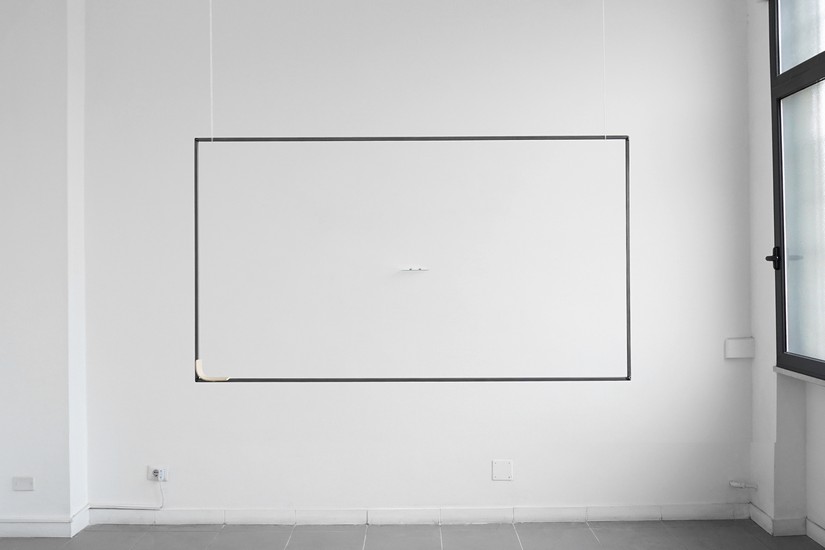
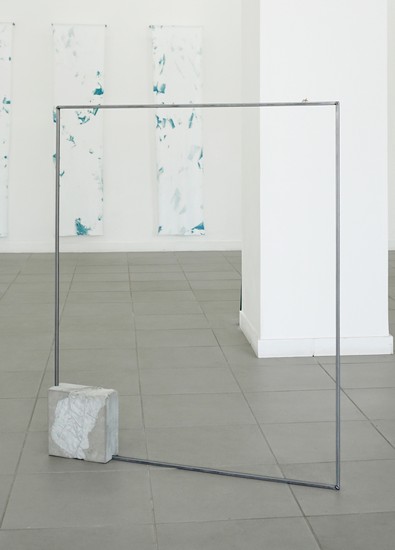
Ordinary objects which are treated as fossils or artefacts, or contemporary elements seen through an archeological view finder, evoke an earlier and different human presence. These are placed in relationship to sculptures that frame the real presence of the visitors who interact with the sculptural work just by their approach – consequently this framing places an image of their own body which is then offered to the view of other visitors. Hence, Harris’s sculptural work invites the audience to activate the work: a “being on and within” the sculptural work through a subtle and gentle performative act. Sculpture-frames and sculpture-objects frame or evoke body parts, referring not only to the relationship between virtual and reality, but also to a hybrid territory where they meet,  and where these two terms breakdown. Such as the ubiquitous screen-based devices that represent an extension of the human body or when we place a part of our body on these devices, for example when, with our fingers, we involuntarily cover a photographic lens.

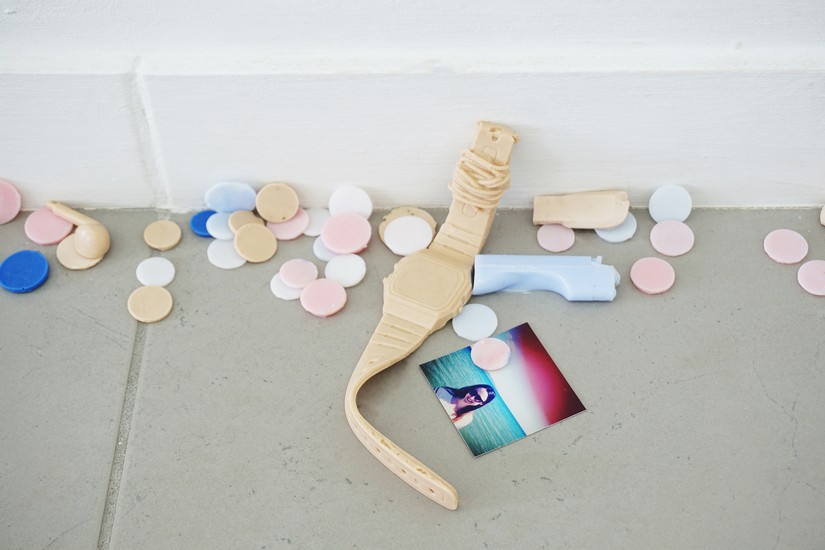
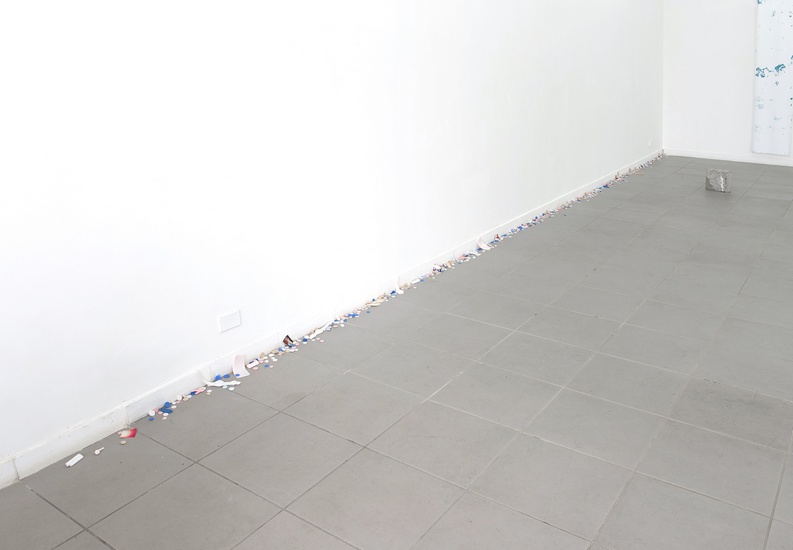
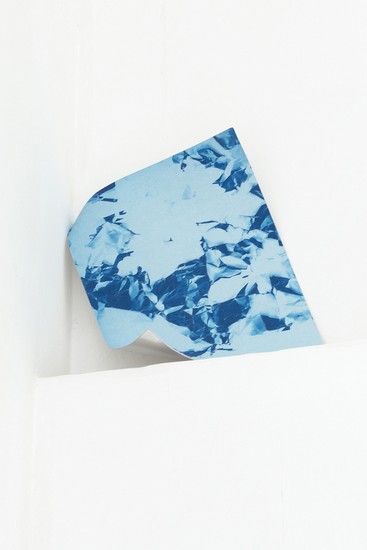
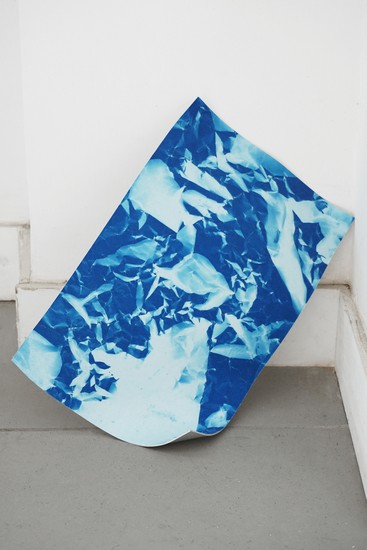
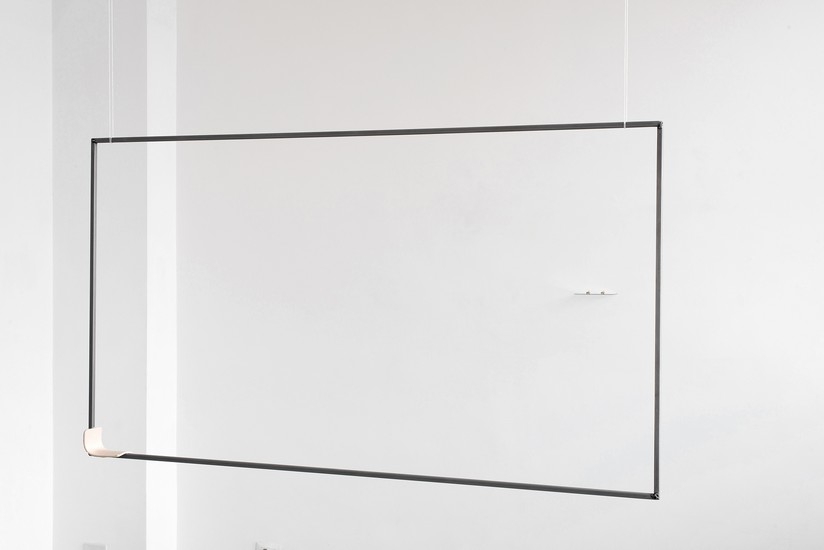
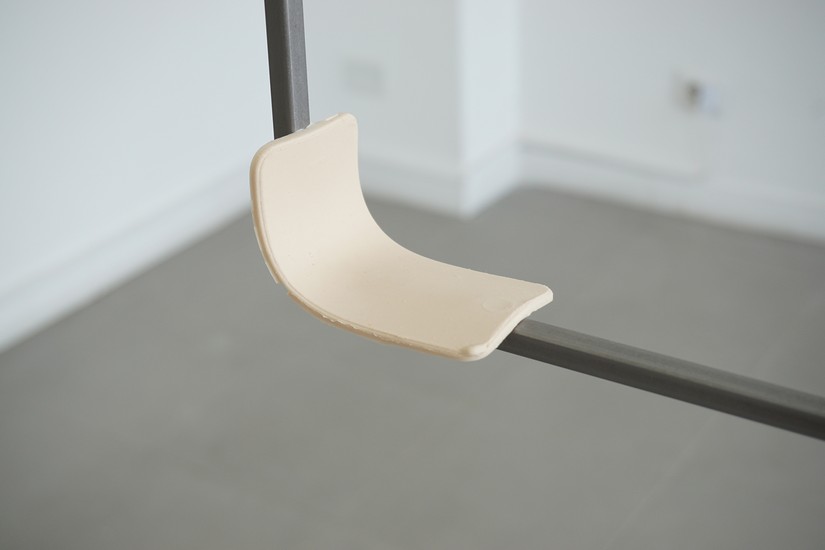
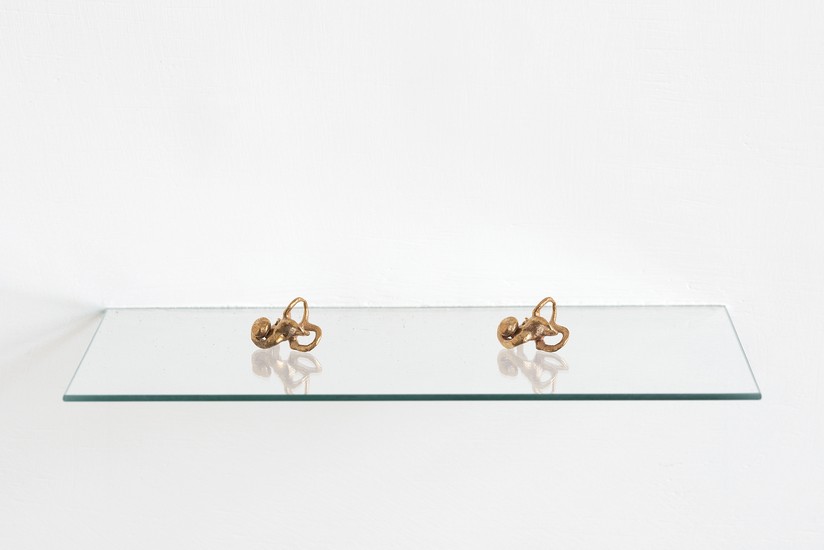
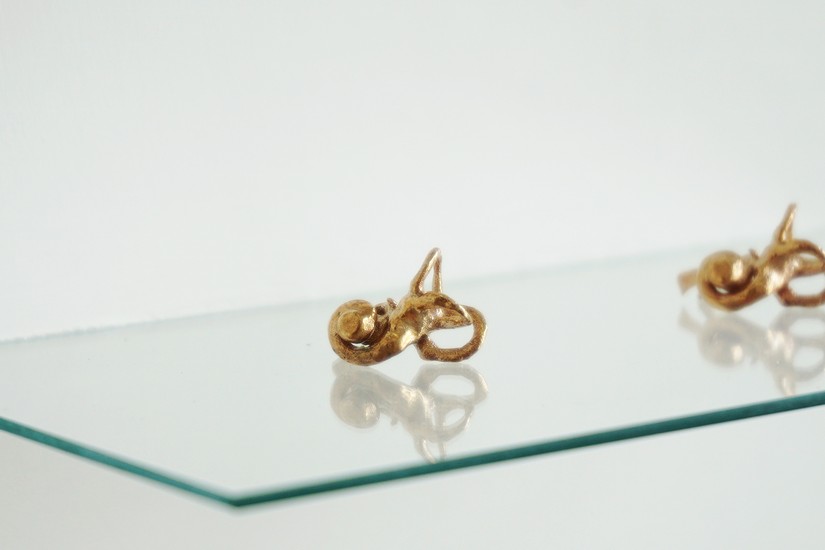
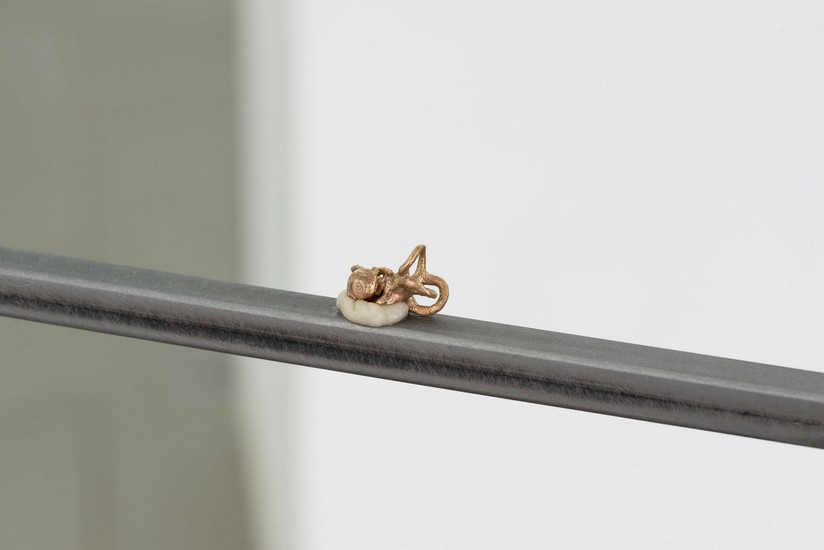
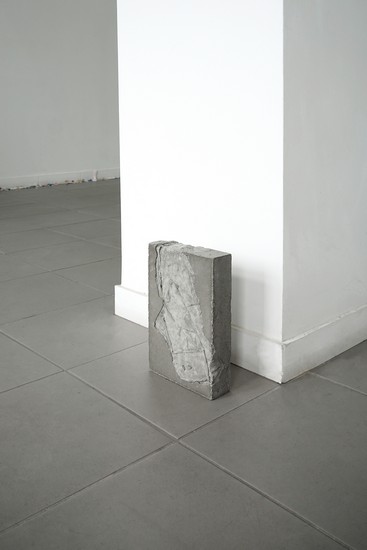
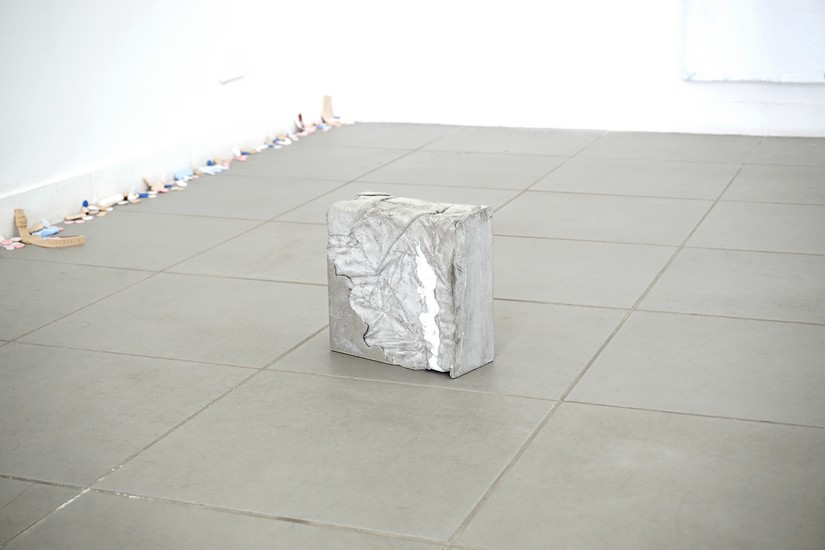
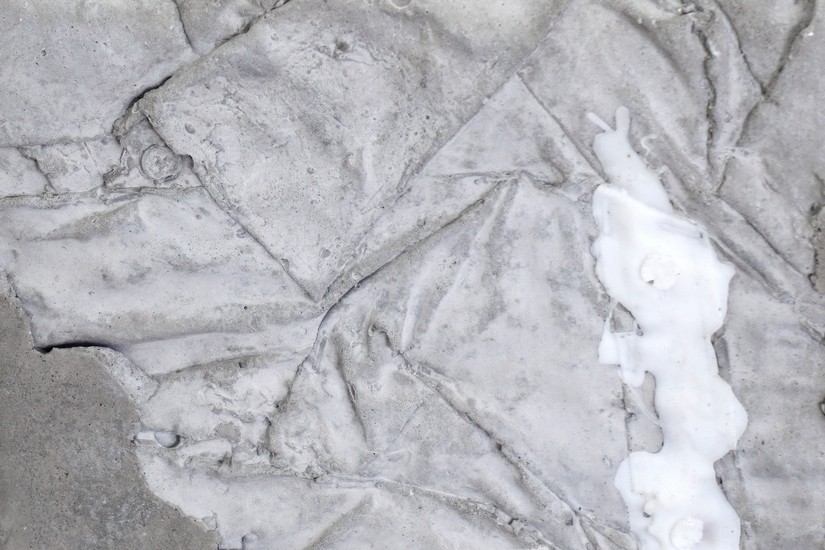
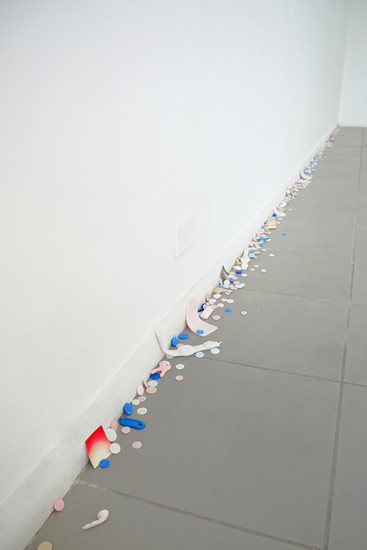
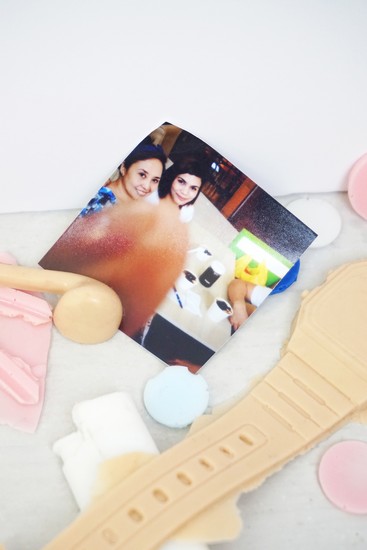
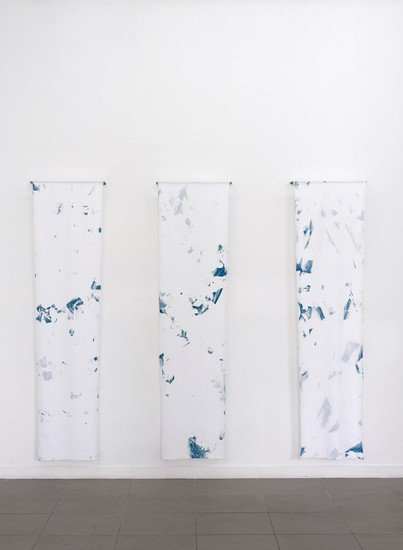
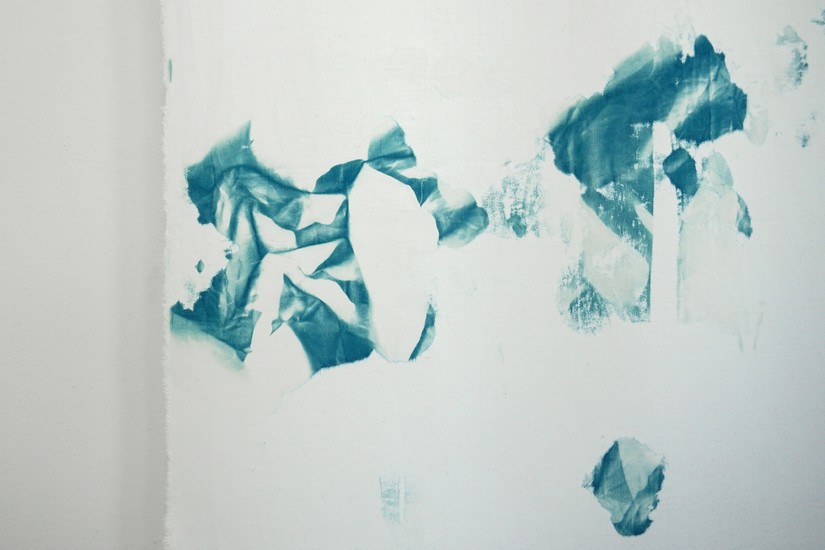
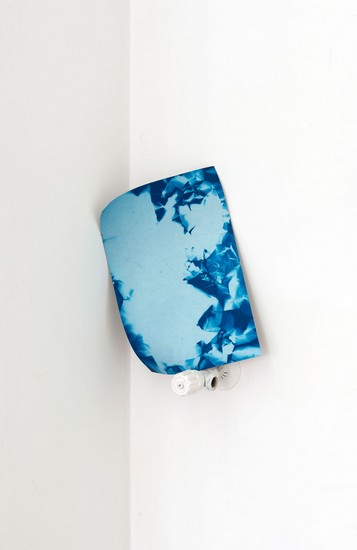
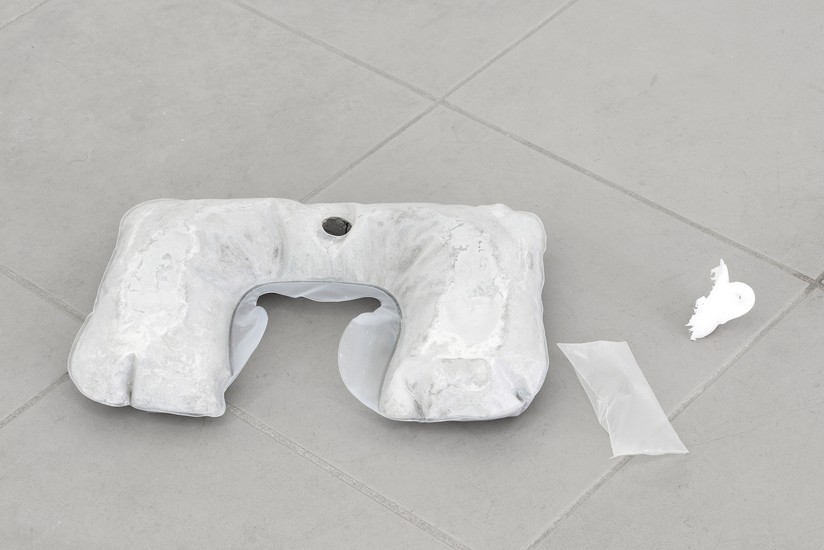
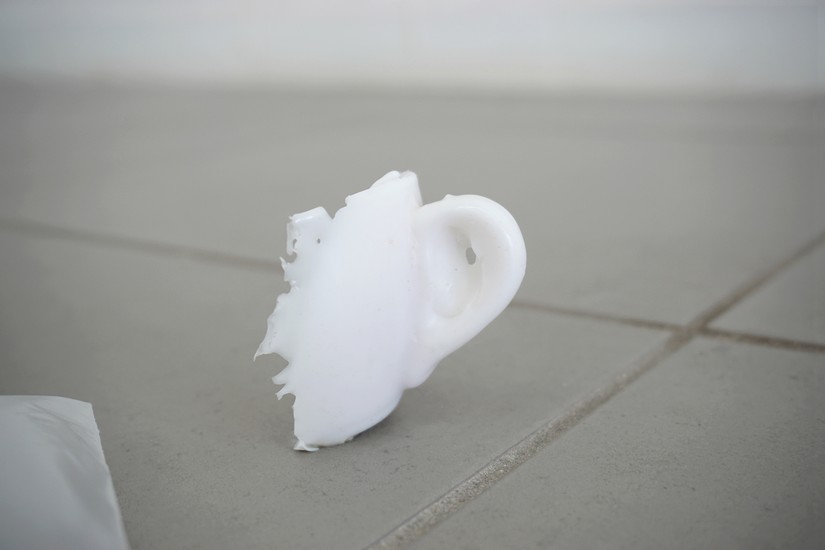
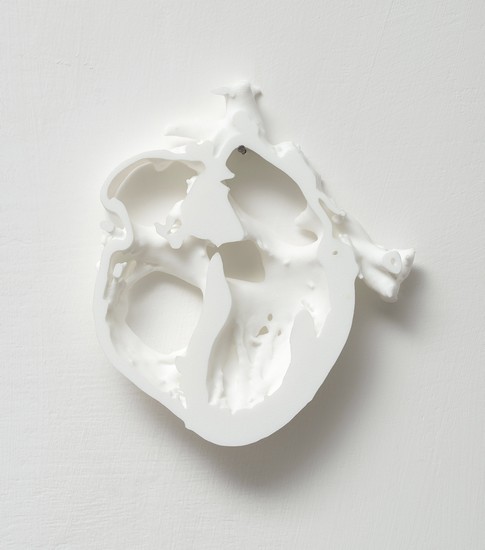
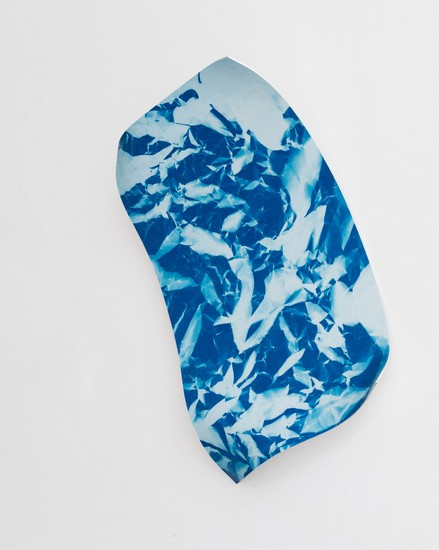
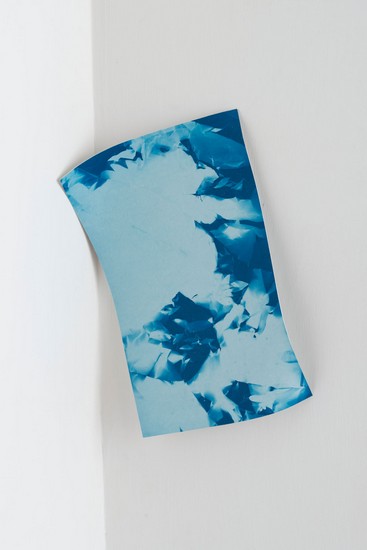
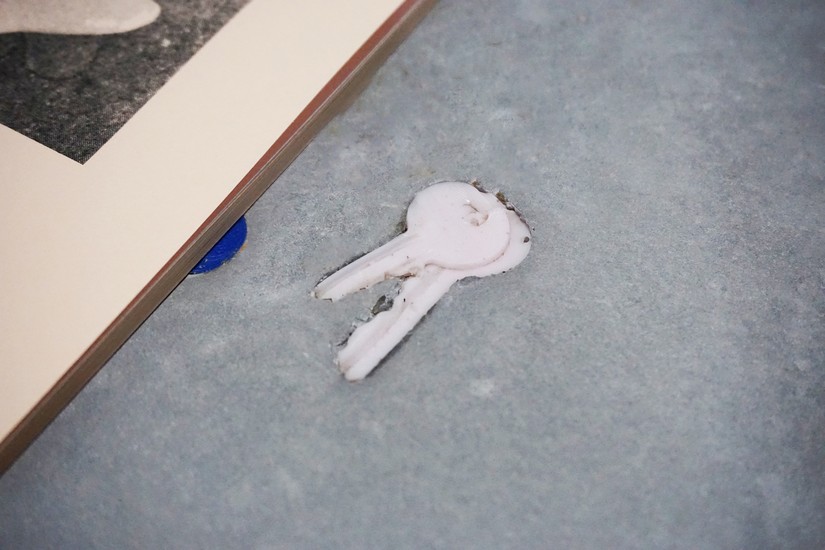
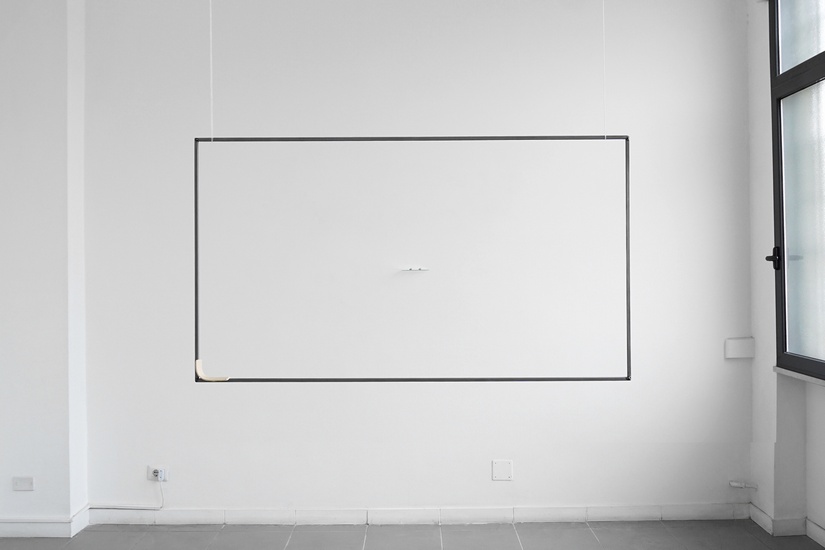
The exhibition is spread across the two floors of the gallery and each floor gives a different modality to the interaction between bodies and sculptures. On the ground floor, the works are alternating and prospectively touching in a constant process of framing and unframing. Sculpture-frames standing in the gallery’s space or hanging from the ceiling contain the image of other sculptures and visitors. The human presence or forms pertaining to a close relationship to the skin are evoked by fragments of shirts or by small objects trapped in the concrete. Silicon rubber micro-sculptures replicating dozens of ordinary objects we carry everyday in our pockets and which here are gathered together to form a strip along the wall as if dropped as cultural detritus. Complementing this are sculptures created through three-dimensional prints of actual human organs, gathered via MRI scans that provide parts of the body we can not see but can digitally reproduced. Finally fabric drapes where cyanotype, the most basic sun-reactive photographic solution, captures the a chance contemporary moment through a human scale process (a length of fabric enough to crumple in the hand and later to hang at human scale).
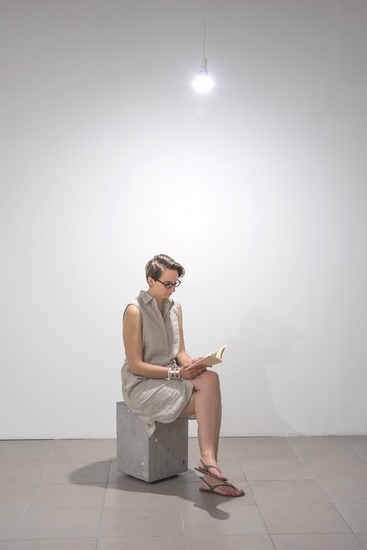
The sculptural work in the basement of the gallery is a place offering a different time interaction, inviting and accommodating human engagement and giving a place to rest the body. The work welcomes the visitors, encourages them to sit and to interact with a book created by the artist and which represents an integral part of the work of art. The book includes a collection of recent writing that Harris has developed in symbiosis with the sculptural work and on  occasion of other previous performances. To the artist, in fact, written language is closely linked with that of sculptural language, where personal perception, imagination, memory and bodily understanding are called upon for a better comprehension of the work.

The Gallery Apart è lieta di presentare la prima personale italiana di Rowena Harris, artista a cui la British School of Rome ha offerto la possibilità di vivere e lavorare a Roma quale Sainsbury Scholar in Sculpture. Dopo quasi un anno di residenza, “Being both on and within, as I said” fa il punto di un’esperienza definita seminale dall’artista stessa che ha potuto ulteriormente sviluppare la sua ricerca sul rapporto tra scultura, oggetto e corpo umano in un contesto storico, architettonico e sociale carico di spunti e sollecitazioni inediti per l’artista di base a Londra.

Rowena Harris è impegnata a comprendere nel profondo la realtà contemporanea, in cui la mente, il corpo, l’io e gli oggetti sono tutti elementi fra loro indissolubilmente legati, al punto che la percezione immaginativa è allo stesso tempo mentale e fisica. Harris usa questa dimensione percettiva all’interno del suo lavoro, con un approccio che coinvolge l’immaginazione dello spettatore, insieme alla traccia del corpo. I lavori esposti e la relazione tra loro esprimono una visione del mondo contemporaneo che può essere intesa come codificata dall’era digitale, ma non limitata al solo spazio digitale. Non vi sono distinzioni tra realtà e virtualità rispetto al modo in cui l’uomo costruisce e vive le sue esperienze.

Oggetti della vita comune trattati come fossili o come manufatti o ancora elementi contemporanei visti con un mirino archeologico evocano una presenza umana precedente e differente. Questi oggetti sono posti in relazione alle sculture che inquadrano la presenza reale del visitatore, il quale interagisce con l’opera per il solo fatto di avvicinarla e conseguentemente di attraversarla, così offrendo l’immagine del proprio corpo alla visione di altri spettatori. In tal senso, la scultura di Harris invita ad attivare l’opera, ad “essere su e dentro” la scultura con una sorta di atto performativo sottile e delicato. Sculture-cornici e sculture-oggetti inquadrano o evocano parti di corpi, in un rimando non solo al rapporto tra realtà e virtualità, ma anche a un territorio ibrido in cui esse vengono a contatto e dove arrivano al punto di rottura. Come nel caso dei tanti dispositivi telematici che costruiscono vere e proprie protesi del corpo umano o come quando parti di un corpo si frammettono rispetto al funzionamento di tali dispositivi, ad esempio se involontariamente copriamo con un dito parte di un obiettivo fotografico.

La mostra si dipana sui due piani della galleria, ciascuno dei quali offre una modalità diversa di interazione tra corpi e sculture. Al piano terreno le opere si alternano e prospetticamente si toccano in un continuo gioco di entrata e uscita nella e dalla cornice. Sculture-cornici in piedi nello spazio o appese al soffitto contengono la visione di altre sculture e dei visitatori. La presenza dell’uomo o forme strettamente connesse alla pelle umana sono evocate da frammenti di camicie o da piccoli oggetti ormai intrappolati nel cemento; o da microsculture in gomma siliconica replicanti decine di oggetti di cui quotidianamente ci svuotiamo le tasche e che qui vengono raggruppati in una striscia rasente il muro, lasciati cadere come detriti culturali; o ancora da sculture consistenti in stampe tridimensionali di organi umani interni realizzate mediante scansioni MRI che riproducono parti del corpo che non si vedono ad occhio nudo ma che possono essere riprodotte digitalmente; o infine da drappi di seta dove la stampa cyanotype, la più elementare tecnica fotografica reagente al sole, coglie casualmente l’attimo attraverso un procedimento a scala umana (un pezzo di stoffa di dimensioni tali da poter essere raggomitolato in una mano e poi appeso a grandezza d’uomo).

Il lavoro scultoreo nel basement della galleria si propone come spazio in grado di offrire una diversa interazione temporale, invitando e coinvolgendo la presenza umana e fornendo un luogo per il riposo del corpo. L’opera accoglie il visitatore, lo spinge a sedersi e a intrattenersi con la lettura di un libro, creato dall’artista e parte integrante dell’opera stessa. Il libro include una raccolta di scritti recenti che Harris ha elaborato in simbiosi con il lavoro scultoreo e in occasione di precedenti performances. Anche la scrittura infatti è per l’artista un linguaggio che entra in connessione con quello scultoreo, un ambito dove l’immaginazione, la memoria e la percezione corporea sono invitate ad attivarsi per una migliore comprensione dell’opera.